


Page 328 - Classification Parameter Estimation & State Estimation An Engg Approach Using MATLAB
P. 328
BOSTON HOUSING CLASSIFICATION PROBLEM                        317


                0.2                             0.2
               0.18                            0.18
               0.16                            0.16
               0.14                            0.14
               0.12                            0.12
              error  0.1                      error  0.1
               0.08                            0.08
               0.06                            0.06
               0.04                            0.04
               0.02                            0.02
                 0                               0
                        1     2      3             0     1     2     3     4
                            degree                         kernel width
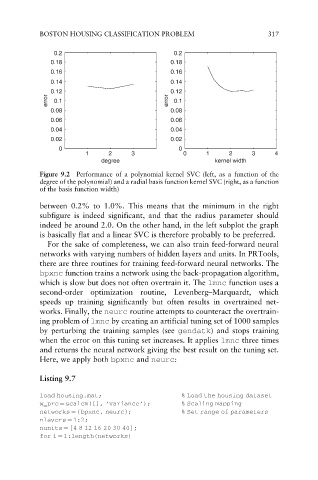
            Figure 9.2 Performance of a polynomial kernel SVC (left, as a function of the
            degree of the polynomial) and a radial basis function kernel SVC (right, as a function
            of the basis function width)

            between 0.2% to 1.0%. This means that the minimum in the right
            subfigure is indeed significant, and that the radius parameter should
            indeed be around 2.0. On the other hand, in the left subplot the graph
            is basically flat and a linear SVC is therefore probably to be preferred.
              For the sake of completeness, we can also train feed-forward neural
            networks with varying numbers of hidden layers and units. In PRTools,
            there are three routines for training feed-forward neural networks. The
            bpxnc function trains a network using the back-propagation algorithm,
            which is slow but does not often overtrain it. The lmnc function uses a
            second-order optimization routine, Levenberg–Marquardt, which
            speeds up training significantly but often results in overtrained net-
            works. Finally, the neurc routine attempts to counteract the overtrain-
            ing problem of lmnc by creating an artificial tuning set of 1000 samples
            by perturbing the training samples (see gendatk) and stops training
            when the error on this tuning set increases. It applies lmnc three times
            and returns the neural network giving the best result on the tuning set.
            Here, we apply both bpxnc and neurc:

            Listing 9.7

            load housing.mat;                     % Load the housing dataset
            w_pre ¼ scalem([], ‘variance’);       % Scaling mapping
            networks ¼ {bpxnc, neurc};            % Set range of parameters
            nlayers ¼ 1:2;
            nunits ¼ [4 8 12 16 20 30 40];
            for i ¼ 1:length(networks)

