


Page 331 - Classification Parameter Estimation & State Estimation An Engg Approach Using MATLAB
P. 331
320                                      WORKED OUT EXAMPLES

                                            observed waveform w(t)


                                                        ↑
                                                       ToF
                                           0      0.005   0.01   0.015   0.02
                                                                      t(s)
                                            zoomed
             waveform        τ = ToF
             generator                 w(t)
                                                  ↑
                              vτ                 ToF

                                              8.5      9       9.5      10
                                                                   t(ms)
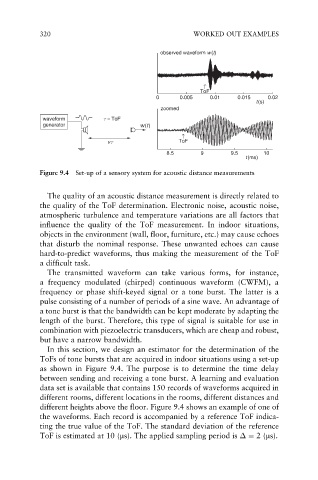
            Figure 9.4  Set-up of a sensory system for acoustic distance measurements

              The quality of an acoustic distance measurement is directly related to
            the quality of the ToF determination. Electronic noise, acoustic noise,
            atmospheric turbulence and temperature variations are all factors that
            influence the quality of the ToF measurement. In indoor situations,
            objects in the environment (wall, floor, furniture, etc.) may cause echoes
            that disturb the nominal response. These unwanted echoes can cause
            hard-to-predict waveforms, thus making the measurement of the ToF
            a difficult task.
              The transmitted waveform can take various forms, for instance,
            a frequency modulated (chirped) continuous waveform (CWFM), a
            frequency or phase shift-keyed signal or a tone burst. The latter is a
            pulse consisting of a number of periods of a sine wave. An advantage of
            a tone burst is that the bandwidth can be kept moderate by adapting the
            length of the burst. Therefore, this type of signal is suitable for use in
            combination with piezoelectric transducers, which are cheap and robust,
            but have a narrow bandwidth.
              In this section, we design an estimator for the determination of the
            ToFs of tone bursts that are acquired in indoor situations using a set-up
            as shown in Figure 9.4. The purpose is to determine the time delay
            between sending and receiving a tone burst. A learning and evaluation
            data set is available that contains 150 records of waveforms acquired in
            different rooms, different locations in the rooms, different distances and
            different heights above the floor. Figure 9.4 shows an example of one of
            the waveforms. Each record is accompanied by a reference ToF indica-
            ting the true value of the ToF. The standard deviation of the reference
            ToF is estimated at 10 (ms). The applied sampling period is   ¼ 2(ms).

