


Page 333 - Classification Parameter Estimation & State Estimation An Engg Approach Using MATLAB
P. 333
322                                      WORKED OUT EXAMPLES

            nominal response h(t), but now time-shifted by t and attenuated by a.
            Such an assumption is correct for a medium like air because, within the
            bandwidth of interest, the propagation of a waveform through air does
            not show a significant dispersion. The attenuation coefficient a depends
            on many factors, but also on the distance, and thus also on t. However,
            for the moment we will ignore this fact. The possible echoes are
            represented by a r(t   t). They share the same time shift t because no
            echo can occur before the arrival of the nominal response. The addi-
            tional time delays of the echoes are implicitly modelled within r(t). The
            echoes and the nominal response also share a common attenuation
            factor. The noise v(t) is considered white.
              The actual shape of the nominal response h(t) depends on the choice
            of the tone burst and on the dynamic properties of the transducers.
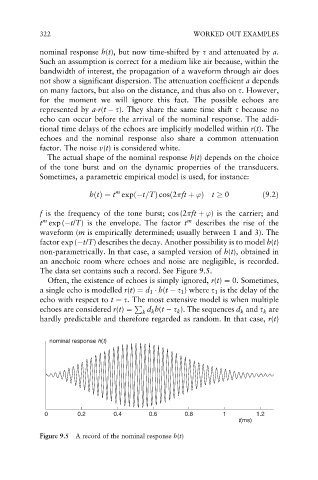
            Sometimes, a parametric empirical model is used, for instance:

                                m
                         hðtÞ¼ t expð t=TÞ cosð2 ft þ ’Þ t   0          ð9:2Þ
            f is the frequency of the tone burst; cos (2 ft þ ’) is the carrier; and
             m
            t exp ( t/T) is the envelope. The factor t m  describes the rise of the
            waveform (m is empirically determined; usually between 1 and 3). The
            factor exp ( t/T) describes the decay. Another possibility is to model h(t)
            non-parametrically. In that case, a sampled version of h(t), obtained in
            an anechoic room where echoes and noise are negligible, is recorded.
            The data set contains such a record. See Figure 9.5.
              Often, the existence of echoes is simply ignored, r(t) ¼ 0. Sometimes,
            a single echo is modelled r(t) ¼ d 1   h(t   t 1 ) where t 1 is the delay of the
            echo with respect to t ¼ t. The most extensive model is when multiple
                                     P
            echoes are considered r(t) ¼  k  d k h(t   t k ). The sequences d k and t k are
            hardly predictable and therefore regarded as random. In that case, r(t)

              nominal response h(t)


             0        0.2       0.4      0.6       0.8       1        1.2
                                                                 t(ms)
            Figure 9.5  A record of the nominal response h(t)

