


Page 337 - Classification Parameter Estimation & State Estimation An Engg Approach Using MATLAB
P. 337
326                                      WORKED OUT EXAMPLES

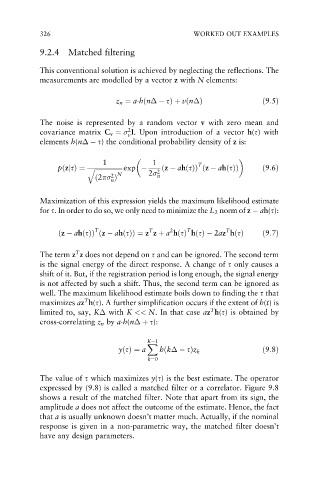
            9.2.4  Matched filtering

            This conventional solution is achieved by neglecting the reflections. The
            measurements are modelled by a vector z with N elements:


                                z n ¼ a hðn    tÞþ vðn Þ                ð9:5Þ

            The noise is represented by a random vector v with zero mean and
                                    2
            covariance matrix C v ¼   I. Upon introduction of a vector h(t) with
                                    v
            elements h(n    t) the conditional probability density of z is:
                             1            1            T
                           ffiffiffiffiffiffiffiffiffiffiffiffiffiffiffiffiffi exp    ðz   ahðtÞÞ ðz   ahðtÞÞ  ð9:6Þ
                 pðzjtÞ¼ q               2  2
                               2 N         n
                           ð2   Þ
                               n
            Maximization of this expression yields the maximum likelihood estimate
            for t. In order to do so, we only need to minimize the L 2 norm of z   ah(t):

                           T             T     2    T         T
                 ðz   ahðtÞÞ ðz   ahðtÞÞ ¼ z z þ a hðtÞ hðtÞ  2az hðtÞ  ð9:7Þ

                     T
            The term z z does not depend on t and can be ignored. The second term
            is the signal energy of the direct response. A change of t only causes a
            shift of it. But, if the registration period is long enough, the signal energy
            is not affected by such a shift. Thus, the second term can be ignored as
            well. The maximum likelihood estimate boils down to finding the t that
                        T
            maximizes az h(t). A further simplification occurs if the extent of h(t)is
                                                          T
            limited to, say, K  with K << N. In that case az h(t) is obtained by
            cross-correlating z n by a h(n  þ t):

                                         K 1
                                         X
                                 yðtÞ¼ a    hðk    tÞz k                ð9:8Þ
                                         k¼0

            The value of t which maximizes y(t) is the best estimate. The operator
            expressed by (9.8) is called a matched filter or a correlator. Figure 9.8
            shows a result of the matched filter. Note that apart from its sign, the
            amplitude a does not affect the outcome of the estimate. Hence, the fact
            that a is usually unknown doesn’t matter much. Actually, if the nominal
            response is given in a non-parametric way, the matched filter doesn’t
            have any design parameters.

