


Page 342 - Classification Parameter Estimation & State Estimation An Engg Approach Using MATLAB
P. 342
TIME-OF-FLIGHT ESTIMATION OF AN ACOUSTIC TONE BURST          331

            value of J such that J << N. Hopefully,
 n is large for the first few n,and
            then drops down rapidly to zero.

            The computational structure of the estimator based on a covariance model
            A straightforward implementation of (9.20) is not very practical. The
            expression must be evaluated for varying values of t. Since the dimen-
            sion of C zjt is large, this is not computationally feasible.
              The problem will be tackled as follows. First, we define a moving
            window for the measurements z n . The window starts at n ¼ i and ends at
            n ¼ i þ I   1. Thus, it comprises I samples. We stack these samples into
            a vector x(i) with elements x n (i) ¼ z nþi . Each value of i corresponds to a
            hypothesized value t ¼ i . Thus, under this hypothesis, the vector x(i)
            contains the direct response with t ¼ 0, i.e. x n (i) ¼ a h(n )þ
            a r(n ) þ v(n ). Instead of applying operation (9.20) for varying t, t is
            fixed to zero and z is replaced by the moving window x(i):

                                     J 1
                                                 T      2
                                     X
                               yðiÞ¼
 n ð0ÞðxðiÞ u n ð0ÞÞ          ð9:21Þ
                                     n¼0
              ^
              i
            If i is the index that maximizes y(i), then the estimate for t is found as
                  ^
            t ^ t cvm ¼ i .
                  i
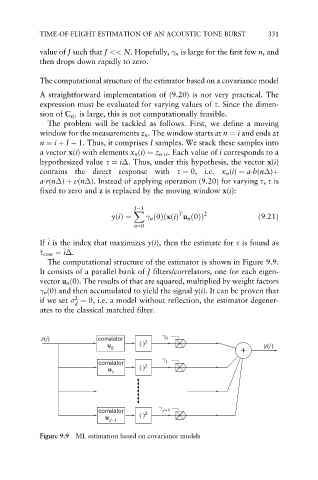
              The computational structure of the estimator is shown in Figure 9.9.
            It consists of a parallel bank of J filters/correlators, one for each eigen-
            vector u n (0). The results of that are squared, multiplied by weight factors

 n (0) and then accumulated to yield the signal y(i). It can be proven that
                     2
            if we set   ¼ 0, i.e. a model without reflection, the estimator degener-
                     d
            ates to the classical matched filter.

                                             γ
            z(i)            correlator  2     0
                              u        ( )                              y(i )
                               0                                  +
                                             γ
                            correlator  2     1
                              u        ( )
                               1


                                            γ
                            correlator  2    J–1
                             u         ( )
                              J–1
            Figure 9.9  ML estimation based on covariance models

