


Page 339 - Classification Parameter Estimation & State Estimation An Engg Approach Using MATLAB
P. 339
328                                      WORKED OUT EXAMPLES

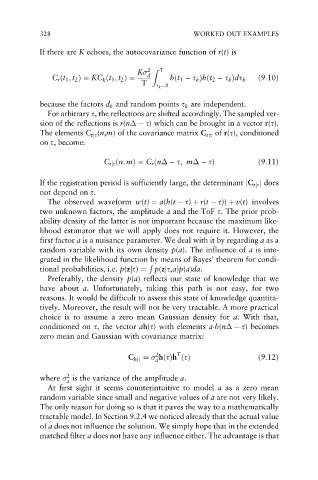
            If there are K echoes, the autocovariance function of r(t)is


                                      K  2 d  Z  T
               C r ðt 1 ; t 2 Þ¼ KC k ðt 1 ; t 2 Þ¼  hðt 1   t k Þhðt 2   t k Þdt k  ð9:10Þ
                                       T   t k ¼0

            because the factors d k and random points t k are independent.
              For arbitrary t, the reflections are shifted accordingly. The sampled ver-
            sion of the reflections is r(n    t) which can be brought in a vector r(t).
            The elements C rjt (n,m)of the covariance matrix C rjt of r(t), conditioned
            on t,become:

                             C rjt ðn; mÞ¼ C r ðn    t; m    tÞ        ð9:11Þ

            If the registration period is sufficiently large, the determinant jC rjt j does
            not depend on t.
              The observed waveform w(t) ¼ a(h(t   t) þ r(t   t)) þ v(t) involves
            two unknown factors, the amplitude a and the ToF t. The prior prob-
            ability density of the latter is not important because the maximum like-
            lihood estimator that we will apply does not require it. However, the
            first factor a is a nuisance parameter. We deal with it by regarding a as a
            random variable with its own density p(a). The influence of a is inte-
            grated in the likelihood function by means of Bayes’ theorem for condi-
                                         R
            tional probabilities, i.e. p(zjt) ¼  p(zjt,a)p(a)da.
              Preferably, the density p(a) reflects our state of knowledge that we
            have about a. Unfortunately, taking this path is not easy, for two
            reasons. It would be difficult to assess this state of knowledge quantita-
            tively. Moreover, the result will not be very tractable. A more practical
            choice is to assume a zero mean Gaussian density for a. With that,
            conditioned on t, the vector ah(t) with elements a h(n    t) becomes
            zero mean and Gaussian with covariance matrix:


                                           2     T
                                    C hjt ¼   hðtÞh ðtÞ                ð9:12Þ
                                           a
                   2
            where   is the variance of the amplitude a.
                   a
              At first sight it seems counterintuitive to model a as a zero mean
            random variable since small and negative values of a are not very likely.
            The only reason for doing so is that it paves the way to a mathematically
            tractable model. In Section 9.2.4 we noticed already that the actual value
            of a does not influence the solution. We simply hope that in the extended
            matched filter a does not have any influence either. The advantage is that

