


Page 329 - Classification Parameter Estimation & State Estimation An Engg Approach Using MATLAB
P. 329
318                                      WORKED OUT EXAMPLES

              for j ¼ 1:length(nlayers)
                for k ¼ 1:length(nunits)
                  % Train a neural network with nlayers(j) hidden layers
                  % of nunits(k) units each, using algorithm network{i}
                  err_nn(i,j,k) ¼ crossval(z, . . .
                    w_pre*networks{i}([],ones(1,nlayers(j))*nunits(k)),5);
                end;
              end;
              figure; clear all;                  % Plot the errors
              plot(nunits,err_nn(i,1,:), ‘-’); hold on;
              plot(nunits,err_nn(i,2,:), ‘--’);
              legend(‘1 hidden layer’, ‘2 hidden layers’);
            end;

            Training neural networks is a computationally intensive process; and
            here they are trained for a large range of parameters, using cross-validation.
            The algorithm above takes more than a day to finish on a modern
            workstation, although per setting just a single neural network is trained.
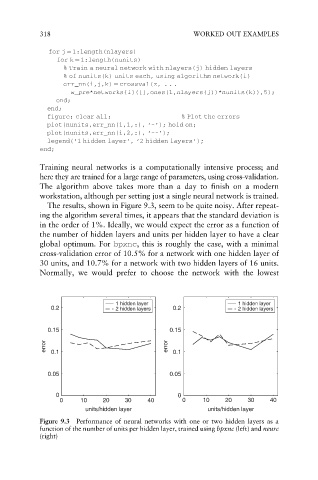
              The results, shown in Figure 9.3, seem to be quite noisy. After repeat-
            ing the algorithm several times, it appears that the standard deviation is
            in the order of 1%. Ideally, we would expect the error as a function of
            the number of hidden layers and units per hidden layer to have a clear
            global optimum. For bpxnc, this is roughly the case, with a minimal
            cross-validation error of 10.5% for a network with one hidden layer of
            30 units, and 10.7% for a network with two hidden layers of 16 units.
            Normally, we would prefer to choose the network with the lowest


                                1 hidden layer                   1 hidden layer
               0.2              2 hidden layers  0.2             2 hidden layers

              0.15                             0.15
             error  0.1                       error  0.1


              0.05                             0.05

                0                                0
                 0     10    20    30    40       0     10    20    30    40
                        units/hidden layer               units/hidden layer
            Figure 9.3 Performance of neural networks with one or two hidden layers as a
            function of the number of units per hidden layer, trained using bpxnc (left) and neurc
            (right)

