


Page 143 - Compression Machinery for Oil and Gas
P. 143
130 SECTION    II Types of Equipment


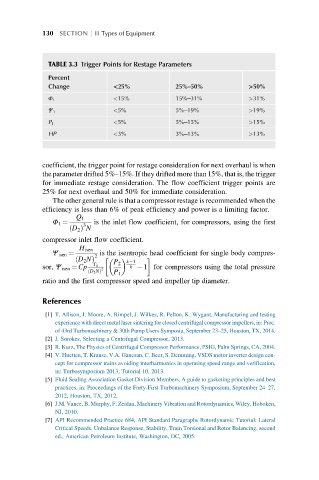
              TABLE 3.3 Trigger Points for Restage Parameters

              Percent
              Change            <25%            25%–50%             >50%
                                <15%            15%–31%             >31%
              Φ 1
                                <5%             5%–19%              >19%
              Ψ 1
                                <5%             5%–15%              >15%
              P 1
              HP                <3%             3%–13%              >13%


            coefficient, the trigger point for restage consideration for next overhaul is when
            the parameter drifted 5%–15%. If they drifted more than 15%, that is, the trigger
            for immediate restage consideration. The flow coefficient trigger points are
            25% for next overhaul and 50% for immediate consideration.
               The other general rule is that a compressor restage is recommended when the
            efficiency is less than 6% of peak efficiency and power is a limiting factor.
                      Q 1
               Φ 1 ¼    3  is the inlet flow coefficient, for compressors, using the first
                    ð D 2 Þ N
            compressor inlet flow coefficient.
                      H isen
               Ψ isen ¼     is the isentropic head coefficient for single body compres-
                     ð D 2 NÞ  2        k 1
                                P 2
            sor, Ψ isen ¼ Cp  T 1  2  k  1 for compressors using the total pressure
                         ð D 2 NÞ
                                P 1
            ratio and the first compressor speed and impeller tip diameter.
            References

             [1] T. Allison, J. Moore, A. Rimpel, J. Wilkes, R. Pelton, K. Wygant, Manufacturing and testing
                experience with direct metal laser sintering for closed centrifugal compressor impellers, in: Proc.
                of 43rd Turbomachinery & 30th Pump Users Symposia, September 23–25, Houston, TX, 2014.
             [2] J. Sorokes, Selecting a Centrifugal Compressor, 2013.
             [3] R. Kurz, The Physics of Centrifugal Compressor Performance, PSIG, Palm Springs, CA, 2004.
             [4] V. Huetten, T. Krause, V.A. Ganesan, C. Beer, S. Demming, VSDS motor inverter design con-
                cept for compressor trains avoiding interharmonics in operating speed range and verification,
                in: Turbosymposium 2013, Tutorial 10, 2013.
             [5] Fluid Sealing Association Gasket Division Members, A guide to gasketing principles and best
                practices, in: Proceedings of the Forty-First Turbomachinery Symposium, September 24–27,
                2012, Houston, TX, 2012.
             [6] J.M. Vance, B. Murphy, F. Zeidan, Machinery Vibration and Rotordynamics, Wiley, Hoboken,
                NJ, 2010.
             [7] API Recommended Practice 684, API Standard Paragraphs Rotordynamic Tutorial: Lateral
                Critical Speeds, Unbalance Response, Stability, Train Torsional and Rotor Balancing, second
                ed., American Petroleum Institute, Washington, DC, 2005.

