


Page 334 - Computational Statistics Handbook with MATLAB
P. 334
Chapter 9: Statistical Pattern Recognition                      323


                                                             Iris Virginica


                                        1.2
                                         1
                                        0.8
                                        0.6
                                        0.4
                                        0.2


                                            3.5
                                                                                       8
                                                   3                            7
                                                       2.5                6
                                                                   5
                                            Sepal Width                   Sepal Length

                               IG
                              FI F U URE G 9.  RE 9. 2  2
                               GU
                                     2
                              F F II  GU  RE RE 9. 9.  2
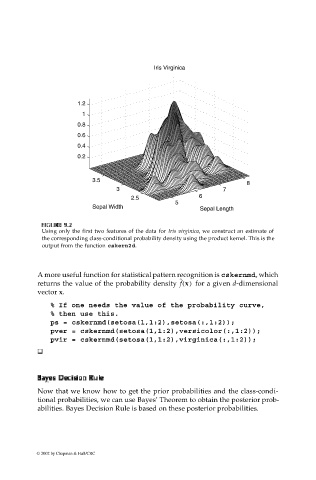
                              Using only the first two features of the data for Iris virginica, we construct an estimate of
                              the corresponding class-conditional probability density using the product kernel. This is the
                              output from the function cskern2d.
                             A more useful function for statistical pattern recognition is cskernmd, which
                                                                    ˆ
                             returns the value of the probability density  f x()   for a given d-dimensional
                             vector x.
                                % If one needs the value of the probability curve,
                                % then use this.
                                ps = cskernmd(setosa(1,1:2),setosa(:,1:2));
                                pver = cskernmd(setosa(1,1:2),versicolor(:,1:2));
                                pvir = cskernmd(setosa(1,1:2),virginica(:,1:2));


                                            ule
                             Ba
                             BBaayeye
                             Bayeye s  ss sDDe  ecisioncisionR  RR uleule
                                           R
                                   DDeecisioncision
                                           ule
                             Now that we know how to get the prior probabilities and the class-condi-
                             tional probabilities, we can use Bayes’ Theorem to obtain the posterior prob-
                             abilities. Bayes Decision Rule is based on these posterior probabilities.

                            © 2002 by Chapman & Hall/CRC

