


Page 344 - Computational Statistics Handbook with MATLAB
P. 344
Chapter 9: Statistical Pattern Recognition                      333


                                 e
                                     eenntt
                             e
                               eependpend
                                        est
                                               ple
                                                ple
                                         TS Sa
                                              amm
                             Ind  ependpend  ennt  tT TTestest est  SS  aamm pleple
                             IndInd
                             Ind
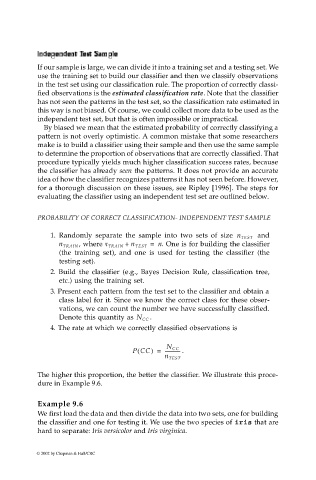
                             If our sample is large, we can divide it into a training set and a testing set. We
                             use the training set to build our classifier and then we classify observations
                             in the test set using our classification rule. The proportion of correctly classi-
                             fied observations is the estimated classification rate. Note that the classifier
                             has not seen the patterns in the test set, so the classification rate estimated in
                             this way is not biased. Of course, we could collect more data to be used as the
                             independent test set, but that is often impossible or impractical.
                              By biased we mean that the estimated probability of correctly classifying a
                             pattern is not overly optimistic. A common mistake that some researchers
                             make is to build a classifier using their sample and then use the same sample
                             to determine the proportion of observations that are correctly classified. That
                             procedure typically yields much higher classification success rates, because
                             the classifier has already seen the patterns. It does not provide an accurate
                             idea of how the classifier recognizes patterns it has not seen before. However,
                             for a thorough discussion on these issues, see Ripley [1996]. The steps for
                             evaluating the classifier using an independent test set are outlined below.
                             PROBABILITY OF CORRECT CLASSIFICATION- INDEPENDENT TEST SAMPLE
                                                                                          and
                                1. Randomly separate the  sample into two sets of size  n TEST
                                        , where n TRAIN +  n TEST =  n . One is for building the classifier
                                   n TRAIN
                                   (the training set), and  one is used for testing the classifier (the
                                   testing set).
                                2.  Build  the  classifier  (e.g., Bayes Decision Rule, classification tree,
                                   etc.) using the training set.
                                3. Present each pattern from the test set to the classifier and obtain a
                                   class label for it. Since we know the correct class for these obser-
                                   vations, we can count the number we have successfully classified.
                                                            .
                                   Denote this quantity as  N CC
                                4. The rate at which we correctly classified observations is


                                                        (
                                                                 N CC
                                                       PCC) =   -------------  .
                                                                n TEST
                             The higher this proportion, the better the classifier. We illustrate this proce-
                             dure in Example 9.6.


                             Example 9.6
                             We first load the data and then divide the data into two sets, one for building
                             the classifier and one for testing it. We use the two species of iris that are
                             hard to separate: Iris versicolor and Iris virginica.


                            © 2002 by Chapman & Hall/CRC

