


Page 340 - Computational Statistics Handbook with MATLAB
P. 340
Chapter 9: Statistical Pattern Recognition                      329


                                     0.25


                                      0.2


                                     0.15


                                      0.1


                                     0.05


                                        0
                                        −6    −4    −2      0     2      4     6     8
                                                           Feature − x
                              FI F IG URE G 9.  RE 9. 6  6
                               U
                                     6
                               GU
                              F F II  GU  RE RE 9. 9.  6
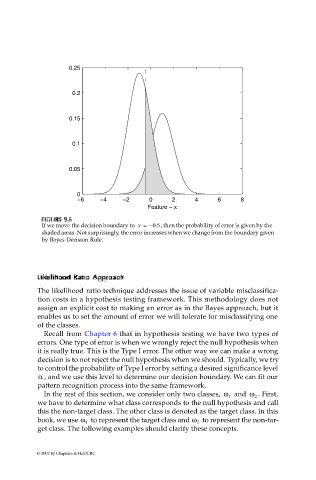
                              If we move the decision boundary to  x =  – 0.5 , then the probability of error is given by the
                              shaded areas. Not surprisingly, the error increases when we change from the boundary given
                              by Bayes Decision Rule.


                                            Approach
                             Likelihood ikelihood  ApproachApproach
                             LRatioikelihoodRatioApproach
                             LLikelihoodRatioRatio
                             The likelihood ratio technique addresses the issue of variable misclassifica-
                             tion costs in a hypothesis testing framework. This methodology does not
                             assign an explicit cost to making an error as in the Bayes approach, but it
                             enables us to set the amount of error we will tolerate for misclassifying one
                             of the classes.
                              Recall from Chapter 6 that in hypothesis testing we have two types of
                             errors. One type of error is when we wrongly reject the null hypothesis when
                             it is really true. This is the Type I error. The other way we can make a wrong
                             decision is to not reject the null hypothesis when we should. Typically, we try
                             to control the probability of Type I error by setting a desired significance level
                             α  , and we use this level to determine our decision boundary. We can fit our
                             pattern recognition process into the same framework.
                                                                                          . First,
                              In the rest of this section, we consider only two classes,  ω 1   and  ω 2
                             we have to determine what class corresponds to the null hypothesis and call
                             this the non-target class. The other class is denoted as the target class. In this
                                                                           to represent the non-tar-
                             book, we use ω 1   to represent the target class and ω 2
                             get class. The following examples should clarify these concepts.


                            © 2002 by Chapman & Hall/CRC

