


Page 342 - Computational Statistics Handbook with MATLAB
P. 342
Chapter 9: Statistical Pattern Recognition                      331


                                     0.25
                                             Target Class           Non−Target Class

                                      0.2
                                           P(x | ω )*P(ω )            P(x | ω )*P(ω )
                                                1   1                      2   2
                                     0.15


                                      0.1


                                     0.05


                                        0
                                        −6    −4    −2      0     2      4     6     8

                               U
                              FI F IG URE G 9.  RE 9. 7  7
                                     7
                               GU
                              F F II  GU  RE RE 9. 9.  7
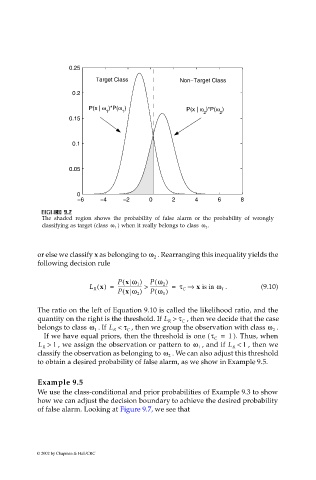
                              The  shaded region  shows  the  probability  of false alarm or the probability of  wrongly
                                                   ) when it really belongs to class  ω 2 .
                              classifying as target (class  ω 1
                             or else we classify x as belonging to ω  2  . Rearranging this inequality yields the
                             following decision rule
                                                   P x ω 1 )  P ω 2 )
                                                             (
                                                    (
                                           L R x() =  -------------------- >  --------------- =  τ C ⇒  x is in ω 1  .  (9.10)
                                                             (
                                                    (
                                                   P x ω 2 )  P ω 1 )
                             The ratio on the left of Equation 9.10 is called the likelihood ratio, and the
                             quantity on the right is the threshold. If L >  τ  C  , then we decide that the case
                                                                 R
                             belongs to class ω 1  . If L < τ C , then we group the observation with class ω 2  .
                                                  R
                              If we have equal priors, then the threshold is one (τ =  1  ). Thus, when
                                                                              C
                             L >  1 , we assign the observation or pattern to  ω 1  , and if  L <  1  , then we
                              R
                                                                                   R
                             classify the observation as belonging to ω  2  . We can also adjust this threshold
                             to obtain a desired probability of false alarm, as we show in Example 9.5.
                             Example 9.5
                             We use the class-conditional and prior probabilities of Example 9.3 to show
                             how we can adjust the decision boundary to achieve the desired probability
                             of false alarm. Looking at Figure 9.7, we see that


                            © 2002 by Chapman & Hall/CRC

