


Page 347 - Computational Statistics Handbook with MATLAB
P. 347
336                        Computational Statistics Handbook with MATLAB


                                % based on the class-conditional probabilities.
                                ncc = 0;
                                % We will use only the first two features of
                                % the iris data for our classification.
                                % This should make it more difficult to
                                % separate the classes.
                                % Delete 3rd and 4th features.
                                virginica(:,3:4) = [];
                                versicolor(:,3:4) = [];
                                [nver,d] = size(versicolor);
                                [nvir,d] = size(virginica);
                                n = nvir + nver;
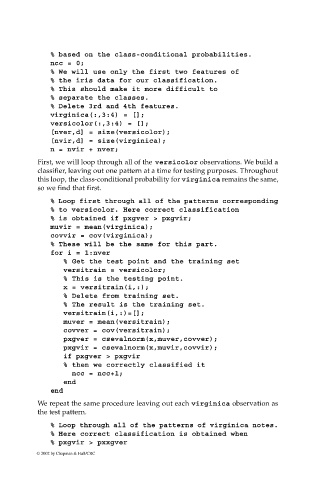
                             First, we will loop through all of the  versicolor observations. We build a
                             classifier, leaving out one pattern at a time for testing purposes. Throughout
                             this loop, the class-conditional probability for virginica remains the same,
                             so we find that first.
                                % Loop first through all of the patterns corresponding
                                % to versicolor. Here correct classification
                                % is obtained if pxgver > pxgvir;
                                muvir = mean(virginica);
                                covvir = cov(virginica);
                                % These will be the same for this part.
                                for i = 1:nver
                                    % Get the test point and the training set
                                    versitrain = versicolor;
                                    % This is the testing point.
                                    x = versitrain(i,:);
                                    % Delete from training set.
                                    % The result is the training set.
                                    versitrain(i,:)=[];
                                    muver = mean(versitrain);
                                    covver = cov(versitrain);
                                    pxgver = csevalnorm(x,muver,covver);
                                    pxgvir = csevalnorm(x,muvir,covvir);
                                    if pxgver > pxgvir
                                    % then we correctly classified it
                                      ncc = ncc+1;
                                    end
                                end
                             We repeat the same procedure leaving out each virginica observation as
                             the test pattern.

                                % Loop through all of the patterns of virginica notes.
                                % Here correct classification is obtained when
                                % pxgvir > pxxgver
                            © 2002 by Chapman & Hall/CRC

