


Page 351 - Computational Statistics Handbook with MATLAB
P. 351
340                        Computational Statistics Handbook with MATLAB


                                2. Leave k points out of the non-target class to form a set of test cases
                                                                                           2 ()
                                   denoted by TEST. We denote cases belonging to class  ω 2   as  x i  .
                                3. Estimate  the class-conditional probabilities  using  the remaining
                                   n –  k   non-target cases and the  n  1   target cases.
                                    2
                                4. For each of those k observations, form the likelihood ratios

                                                      P x (  2 ()  ω )  2 ()
                                                 2 ()
                                               (
                                                         i
                                                             1
                                             L R x i ) =  -------------------------;  x i  in TEST  .
                                                          2 ()
                                                        (
                                                      P x i  ω 2 )
                                5. Repeat steps 2 through 4 using all of the non-target cases.
                                6. Order the likelihood ratios for the non-target class.
                                7. For each probability of false alarm, find the threshold that yields
                                   that value. For example, if the P(FA) = 0.1, then the threshold is
                                                      ˆ   of the likelihood ratios. Note that higher
                                   given by the quantile q 0.9
                                   values of the likelihood ratios indicate the target class.  We now
                                   have an array of thresholds corresponding to each probability of
                                   false alarm.
                                8. Leave  k points out of the target class to form a set of test cases
                                                                                      1 ()
                                   denoted by TEST. We denote cases belonging to  ω 1   by  x i  .
                                9. Estimate  the class-conditional probabilities  using  the remaining
                                   n 1 –  k   target cases and the  n 2   non-target cases.
                                10. For each of those k observations, form the likelihood ratios


                                                        (  1 ()  ω 1 )
                                                  1 ()
                                                       P x i
                                               (
                                                                      1
                                             L R x i ) =  -------------------------;  x i  in TEST  .
                                                          1 ()
                                                       P x (  ω )
                                                          i   2
                                11. Repeat steps 8 through 10 using all of the target cases.
                                12. Order the likelihood ratios for the target class.
                                13. For each threshold and probability of false alarm, find the propor-
                                   tion  of target  cases that are correctly classified to obtain  the
                                                                        1 ()
                                                                     (
                                    (
                                   PCC Target ).   If the likelihood ratios  L R x i )   are sorted,  then this
                                   would be the number of cases that are greater than the threshold.
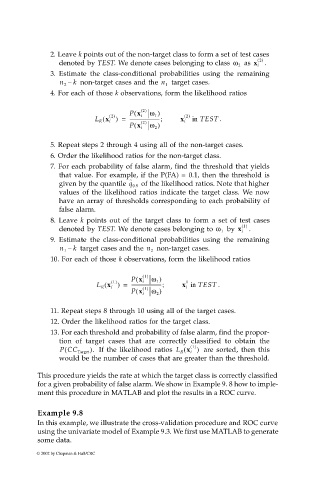
                             This procedure yields the rate at which the target class is correctly classified
                             for a given probability of false alarm. We show in Example 9. 8 how to imple-
                             ment this procedure in MATLAB and plot the results in a ROC curve.

                             Example 9.8
                             In this example, we illustrate the cross-validation procedure and ROC curve
                             using the univariate model of Example 9.3. We first use MATLAB to generate
                             some data.
                            © 2002 by Chapman & Hall/CRC

