


Page 352 - Computational Statistics Handbook with MATLAB
P. 352
Chapter 9: Statistical Pattern Recognition                      341


                                % Generate some data, use the model in Example 9.3.
                                % p(x|w1) ~ N(-1,1), p(w1) = 0.6
                                % p(x|w2) ~ N(1,1),p(w2) = 0.4;
                                % Generate the random variables.
                                n = 1000;
                                u = rand(1,n);% find out what class they are from
                                n1 = length(find(u <= 0.6));% # in target class
                                n2 = n-n1;
                                x1 = randn(1,n1) - 1;
                                x2 = randn(1,n2) + 1;
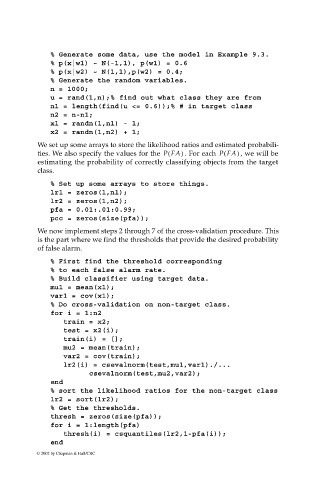
                             We set up some arrays to store the likelihood ratios and estimated probabili-
                             ties. We also specify the values for the  PFA(  ) . For each  PFA(  )  , we will be
                             estimating the probability of correctly classifying objects from the target
                             class.

                                % Set up some arrays to store things.
                                lr1 = zeros(1,n1);
                                lr2 = zeros(1,n2);
                                pfa = 0.01:.01:0.99;
                                pcc = zeros(size(pfa));
                             We now implement steps 2 through 7 of the cross-validation procedure. This
                             is the part where we find the thresholds that provide the desired probability
                             of false alarm.

                                % First find the threshold corresponding
                                % to each false alarm rate.
                                % Build classifier using target data.
                                mu1 = mean(x1);
                                var1 = cov(x1);
                                % Do cross-validation on non-target class.
                                for i = 1:n2
                                    train = x2;
                                    test = x2(i);
                                    train(i) = [];
                                    mu2 = mean(train);
                                    var2 = cov(train);
                                    lr2(i) = csevalnorm(test,mu1,var1)./...
                                           csevalnorm(test,mu2,var2);
                                end
                                % sort the likelihood ratios for the non-target class
                                lr2 = sort(lr2);
                                % Get the thresholds.
                                thresh = zeros(size(pfa));
                                for i = 1:length(pfa)
                                    thresh(i) = csquantiles(lr2,1-pfa(i));
                                end
                            © 2002 by Chapman & Hall/CRC

