


Page 355 - Computational Statistics Handbook with MATLAB
P. 355
344                        Computational Statistics Handbook with MATLAB


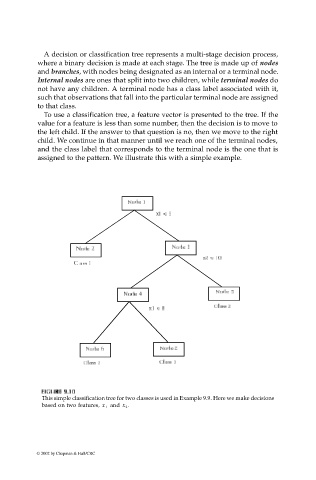
                              A decision or classification tree represents a multi-stage decision process,
                             where a binary decision is made at each stage. The tree is made up of nodes
                             and branches, with nodes being designated as an internal or a terminal node.
                             Internal nodes are ones that split into two children, while terminal nodes do
                             not have any children. A terminal node has a class label associated with it,
                             such that observations that fall into the particular terminal node are assigned
                             to that class.
                              To use a classification tree, a feature vector is presented to the tree. If the
                             value for a feature is less than some number, then the decision is to move to
                             the left child. If the answer to that question is no, then we move to the right
                             child. We continue in that manner until we reach one of the terminal nodes,
                             and the class label that corresponds to the terminal node is the one that is
                             assigned to the pattern. We illustrate this with a simple example.


                                                      de No 1
                                                              x1 < 5


                                                                  de No 3
                                        No de 2
                                                                           2<1
                                                                           0
                                                                           x
                                       Class 1

                                                                              Node 5
                                                     Nod e 4
                                                                              s Clas 2
                                                            1<8
                                                            x


                                                               e Nod 7
                                          Nod e 6
                                                               s Clas 1
                                          s Clas 2


                               IG
                               GU
                              F F FI F U URE GU 9.1  RE RE RE 9.1 0  0 0 0
                               II
                                  9.1
                                  9.1
                               G
                              This simple classification tree for two classes is used in Example 9.9. Here we make decisions
                                                 and  x 2 .
                              based on two features,  x 1
                            © 2002 by Chapman & Hall/CRC

