


Page 111 -
P. 111
84  CHAPTER 3 / A TOP-LEVEL VIEW OF COMPUTER FUNCTION

                                      Read
                                                  Memory
                                      Write
                                                   N words
                                                     0           Data
                                     Address
                                                     •
                                                     •
                                                     •
                                      Data         N – 1


                                      Read
                                                 I/O module     Internal
                                      Write                      data
                                                                External
                                     Address       M ports       data
                                     Internal
                                      data                      Interrupt
                                                                 signals
                                     External
                                      data


                                    Instructions                Address

                                                                Control
                                      Data          CPU          signals

                                     Interrupt                   Data
                                      signals

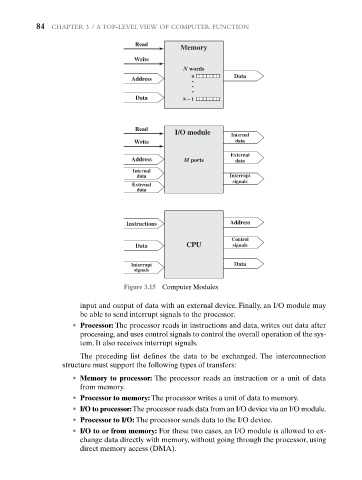
                                   Figure 3.15 Computer Modules

                       input and output of data with an external device. Finally, an I/O module may
                       be able to send interrupt signals to the processor.
                     • Processor: The processor reads in instructions and data, writes out data after
                       processing, and uses control signals to control the overall operation of the sys-
                       tem. It also receives interrupt signals.
                       The preceding list defines the data to be exchanged. The interconnection
                  structure must support the following types of transfers:
                     • Memory to processor: The processor reads an instruction or a unit of data
                       from memory.
                     • Processor to memory: The processor writes a unit of data to memory.
                     • I/O to processor:The processor reads data from an I/O device via an I/O module.
                     • Processor to I/O: The processor sends data to the I/O device.
                     • I/O to or from memory: For these two cases, an I/O module is allowed to ex-
                       change data directly with memory, without going through the processor, using
                       direct memory access (DMA).

