


Page 144 -
P. 144
4.1 / COMPUTER MEMORY SYSTEM OVERVIEW 115

                  requirements, the designer needs to use expensive, relatively lower-capacity memo-
                  ries with short access times.
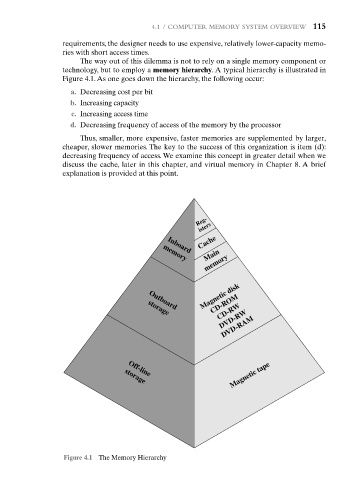
                       The way out of this dilemma is not to rely on a single memory component or
                  technology, but to employ a memory hierarchy. A typical hierarchy is illustrated in
                  Figure 4.1.As one goes down the hierarchy, the following occur:
                    a. Decreasing cost per bit
                    b. Increasing capacity
                    c. Increasing access time
                    d. Decreasing frequency of access of the memory by the processor
                       Thus, smaller, more expensive, faster memories are supplemented by larger,
                  cheaper, slower memories. The key to the success of this organization is item (d):
                  decreasing frequency of access. We examine this concept in greater detail when we
                  discuss the cache, later in this chapter, and virtual memory in Chapter 8. A brief
                  explanation is provided at this point.


                                                       Reg-
                                                        isters
                                                        Cache
                                                         Main
                                               Inboard
                                                         memory
                                              memory

                                                        Magnetic disk
                                                           CD-ROM
                                                             CD-RW
                                          Outboard
                                                             DVD-RW
                                         storage
                                                              DVD-RAM


                                                                Magnetic tape
                                    Off-line
                                   storage


                  Figure 4.1  The Memory Hierarchy

