


Page 145 -
P. 145
116  CHAPTER 4 / CACHE MEMORY


                   Example 4.1  Suppose that the processor has access to two levels of memory. Level 1
                   contains 1000 words and has an access time of 0.01  s; level 2 contains 100,000 words and
                                                           m
                                       m
                   has an access time of 0.1  s. Assume that if a word to be accessed is in level 1, then the
                   processor accesses it directly. If it is in level 2, then the word is first transferred to level 1
                   and then accessed by the processor. For simplicity, we ignore the time required for the
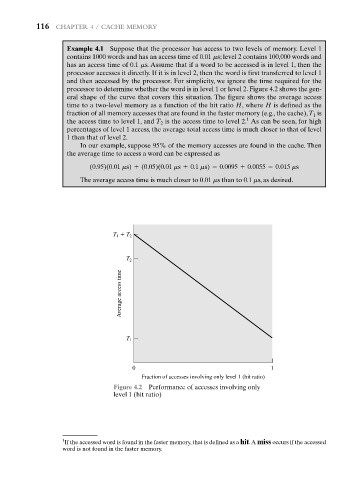
                   processor to determine whether the word is in level 1 or level 2. Figure 4.2 shows the gen-
                   eral shape of the curve that covers this situation. The figure shows the average access
                   time to a two-level memory as a function of the hit ratio H, where H is defined as the
                   fraction of all memory accesses that are found in the faster memory (e.g., the cache), T 1 is
                                                                    1
                   the access time to level 1, and T 2 is the access time to level 2. As can be seen, for high
                   percentages of level 1 access, the average total access time is much closer to that of level
                   1 than that of level 2.
                       In our example, suppose 95% of the memory accesses are found in the cache. Then
                   the average time to access a word can be expressed as
                          (0.95)(0.01 ms) + (0.05)(0.01 ms + 0.1 ms) = 0.0095 + 0.0055 = 0.015 ms
                       The average access time is much closer to 0.01  s than to 0.1  s, as desired.mm


                                T 1    T 2


                                    T 2
                                  Average access time


                                    T 1


                                     0                                     1
                                        Fraction of accesses involving only level 1 (hit ratio)
                                Figure 4.2 Performance of accesses involving only
                                level 1 (hit ratio)


                  1 If the accessed word is found in the faster memory, that is defined as a hit.A miss occurs if the accessed
                  word is not found in the faster memory.

