


Page 150 -
P. 150
4.3 / ELEMENTS OF CACHE DESIGN 121


                                                    Address


                                                                          Address
                                                                           buffer


                                                                                        System bus
                                       Control                        Control
                       Processor                     Cache


                                                                            Data
                                                                           buffer


                                                     Data


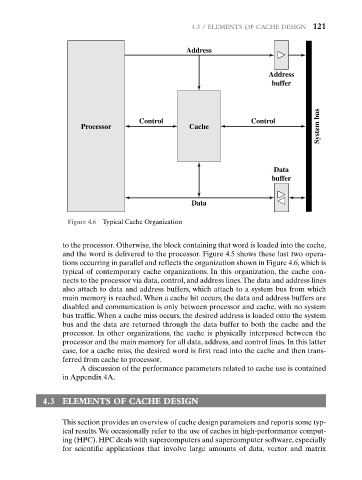
                   Figure 4.6  Typical Cache Organization


                  to the processor. Otherwise, the block containing that word is loaded into the cache,
                  and the word is delivered to the processor. Figure 4.5 shows these last two opera-
                  tions occurring in parallel and reflects the organization shown in Figure 4.6, which is
                  typical of contemporary cache organizations. In this organization, the cache con-
                  nects to the processor via data, control, and address lines.The data and address lines
                  also attach to data and address buffers, which attach to a system bus from which
                  main memory is reached. When a cache hit occurs, the data and address buffers are
                  disabled and communication is only between processor and cache, with no system
                  bus traffic. When a cache miss occurs, the desired address is loaded onto the system
                  bus and the data are returned through the data buffer to both the cache and the
                  processor. In other organizations, the cache is physically interposed between the
                  processor and the main memory for all data, address, and control lines. In this latter
                  case, for a cache miss, the desired word is first read into the cache and then trans-
                  ferred from cache to processor.
                       A discussion of the performance parameters related to cache use is contained
                  in Appendix 4A.


             4.3 ELEMENTS OF CACHE DESIGN


                  This section provides an overview of cache design parameters and reports some typ-
                  ical results.We occasionally refer to the use of caches in high-performance comput-
                  ing (HPC). HPC deals with supercomputers and supercomputer software, especially
                  for scientific applications that involve large amounts of data, vector and matrix

