


Page 151 -
P. 151
122  CHAPTER 4 / CACHE MEMORY

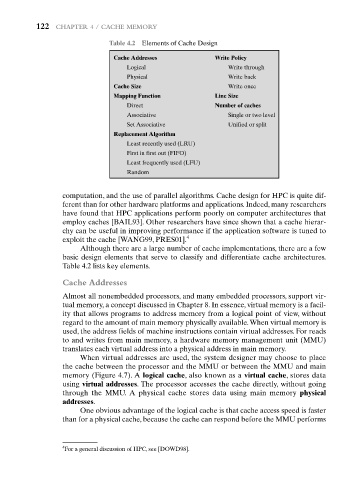
                               Table 4.2 Elements of Cache Design

                                Cache Addresses             Write Policy
                                    Logical                    Write through
                                    Physical                   Write back
                                Cache Size                     Write once
                                Mapping Function            Line Size
                                    Direct                  Number of caches
                                    Associative                Single or two level
                                    Set Associative            Unified or split
                                Replacement Algorithm
                                    Least recently used (LRU)
                                    First in first out (FIFO)
                                    Least frequently used (LFU)
                                    Random


                  computation, and the use of parallel algorithms. Cache design for HPC is quite dif-
                  ferent than for other hardware platforms and applications. Indeed, many researchers
                  have found that HPC applications perform poorly on computer architectures that
                  employ caches [BAIL93]. Other researchers have since shown that a cache hierar-
                  chy can be useful in improving performance if the application software is tuned to
                  exploit the cache [WANG99, PRES01]. 4
                       Although there are a large number of cache implementations, there are a few
                  basic design elements that serve to classify and differentiate cache architectures.
                  Table 4.2 lists key elements.

                  Cache Addresses
                  Almost all nonembedded processors, and many embedded processors, support vir-
                  tual memory, a concept discussed in Chapter 8. In essence, virtual memory is a facil-
                  ity that allows programs to address memory from a logical point of view, without
                  regard to the amount of main memory physically available.When virtual memory is
                  used, the address fields of machine instructions contain virtual addresses. For reads
                  to and writes from main memory, a hardware memory management unit (MMU)
                  translates each virtual address into a physical address in main memory.
                       When virtual addresses are used, the system designer may choose to place
                  the cache between the processor and the MMU or between the MMU and main
                  memory (Figure 4.7). A logical cache, also known as a virtual cache, stores data
                  using virtual addresses. The processor accesses the cache directly, without going
                  through the MMU. A physical cache stores data using main memory  physical
                  addresses.
                       One obvious advantage of the logical cache is that cache access speed is faster
                  than for a physical cache, because the cache can respond before the MMU performs


                  4 For a general discussion of HPC, see [DOWD98].

