


Page 152 -
P. 152
4.3 / ELEMENTS OF CACHE DESIGN 123


                               Logical address              Physical address
                                                MMU
                                                                               Main
               Processor
                                 Cache                                        memory


                                                 Data


                                             (a) Logical cache


                               Logical address              Physical address
                                                MMU
                                                                               Main
               Processor
                                                                              memory
                                                              Cache


                                                 Data

                                             (b) Physical cache
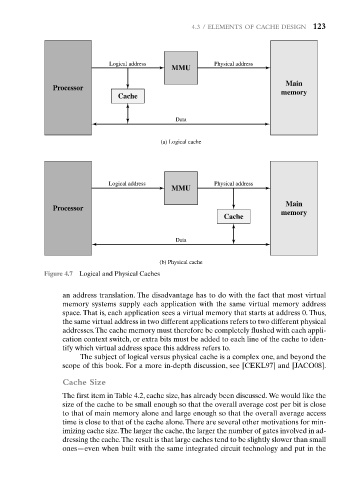
             Figure 4.7 Logical and Physical Caches


                  an address translation. The disadvantage has to do with the fact that most virtual
                  memory systems supply each application with the same virtual memory address
                  space. That is, each application sees a virtual memory that starts at address 0. Thus,
                  the same virtual address in two different applications refers to two different physical
                  addresses.The cache memory must therefore be completely flushed with each appli-
                  cation context switch, or extra bits must be added to each line of the cache to iden-
                  tify which virtual address space this address refers to.
                       The subject of logical versus physical cache is a complex one, and beyond the
                  scope of this book. For a more in-depth discussion, see [CEKL97] and [JACO08].

                  Cache Size
                  The first item in Table 4.2, cache size, has already been discussed.We would like the
                  size of the cache to be small enough so that the overall average cost per bit is close
                  to that of main memory alone and large enough so that the overall average access
                  time is close to that of the cache alone.There are several other motivations for min-
                  imizing cache size.The larger the cache, the larger the number of gates involved in ad-
                  dressing the cache.The result is that large caches tend to be slightly slower than small
                  ones—even when built with the same integrated circuit technology and put in the

