


Page 141 -
P. 141
112  CHAPTER 4 / CACHE MEMORY

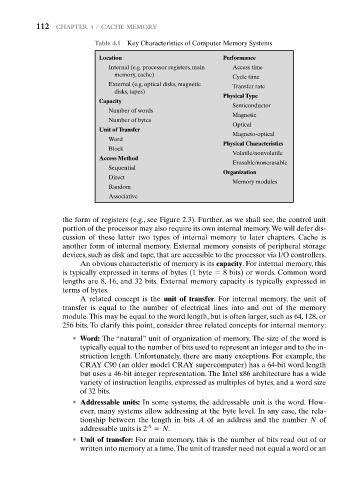
                           Table 4.1 Key Characteristics of Computer Memory Systems

                            Location                          Performance
                               Internal (e.g. processor registers, main   Access time
                                memory, cache)                   Cycle time
                               External (e.g. optical disks, magnetic   Transfer rate
                                disks, tapes)
                                                              Physical Type
                            Capacity
                                                                 Semiconductor
                               Number of words
                                                                 Magnetic
                               Number of bytes
                                                                 Optical
                            Unit of Transfer
                                                                 Magneto-optical
                               Word
                                                              Physical Characteristics
                               Block
                                                                 Volatile/nonvolatile
                            Access Method
                                                                 Erasable/nonerasable
                               Sequential
                                                              Organization
                               Direct
                                                                 Memory modules
                               Random
                               Associative
                  the form of registers (e.g., see Figure 2.3). Further, as we shall see, the control unit
                  portion of the processor may also require its own internal memory.We will defer dis-
                  cussion of these latter two types of internal memory to later chapters. Cache is
                  another form of internal memory. External memory consists of peripheral storage
                  devices, such as disk and tape, that are accessible to the processor via I/O controllers.
                       An obvious characteristic of memory is its capacity. For internal memory, this
                  is typically expressed in terms of bytes (1 byte =  8 bits) or words. Common word
                  lengths are 8, 16, and 32 bits. External memory capacity is typically expressed in
                  terms of bytes.
                       A related concept is the  unit of transfer. For internal memory, the unit of
                  transfer is equal to the number of electrical lines into and out of the memory
                  module.This may be equal to the word length, but is often larger, such as 64, 128, or
                  256 bits. To clarify this point, consider three related concepts for internal memory:
                     • Word: The “natural” unit of organization of memory. The size of the word is
                       typically equal to the number of bits used to represent an integer and to the in-
                       struction length. Unfortunately, there are many exceptions. For example, the
                       CRAY C90 (an older model CRAY supercomputer) has a 64-bit word length
                       but uses a 46-bit integer representation. The Intel x86 architecture has a wide
                       variety of instruction lengths, expressed as multiples of bytes, and a word size
                       of 32 bits.
                     • Addressable units: In some systems, the addressable unit is the word. How-
                       ever, many systems allow addressing at the byte level. In any case, the rela-
                       tionship between the length in bits  A of an address and the number  N of
                       addressable units is 2 A  =  N.
                     • Unit of transfer: For main memory, this is the number of bits read out of or
                       written into memory at a time.The unit of transfer need not equal a word or an

