


Page 182 -
P. 182
152  CHAPTER 4 / CACHE MEMORY

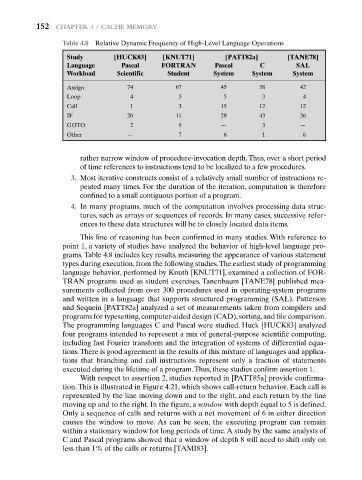
                  Table 4.8 Relative Dynamic Frequency of High-Level Language Operations

                   Study        [HUCK83]     [KNUT71]          [PATT82a]        [TANE78]
                   Language       Pascal     FORTRAN        Pascal      C         SAL
                   Workload      Scientific    Student     System     System     System

                   Assign           74           67          45         38         42
                   Loop              4            3           5          3          4
                   Call              1            3          15         12         12
                   IF               20           11          29         43         36
                   GOTO              2            9          —           3         —
                   Other            —             7           6          1          6


                       rather narrow window of procedure-invocation depth. Thus, over a short period
                       of time references to instructions tend to be localized to a few procedures.
                    3. Most iterative constructs consist of a relatively small number of instructions re-
                       peated many times. For the duration of the iteration, computation is therefore
                       confined to a small contiguous portion of a program.
                    4. In many programs, much of the computation involves processing data struc-
                       tures, such as arrays or sequences of records. In many cases, successive refer-
                       ences to these data structures will be to closely located data items.
                       This line of reasoning has been confirmed in many studies. With reference to
                  point 1, a variety of studies have analyzed the behavior of high-level language pro-
                  grams. Table 4.8 includes key results, measuring the appearance of various statement
                  types during execution, from the following studies.The earliest study of programming
                  language behavior, performed by Knuth [KNUT71], examined a collection of FOR-
                  TRAN programs used as student exercises. Tanenbaum [TANE78] published mea-
                  surements collected from over 300 procedures used in operating-system programs
                  and written in a language that supports structured programming (SAL). Patterson
                  and Sequein [PATT82a] analyzed a set of measurements taken from compilers and
                  programs for typesetting, computer-aided design (CAD), sorting, and file comparison.
                  The programming languages C and Pascal were studied. Huck [HUCK83] analyzed
                  four programs intended to represent a mix of general-purpose scientific computing,
                  including fast Fourier transform and the integration of systems of differential equa-
                  tions.There is good agreement in the results of this mixture of languages and applica-
                  tions that branching and call instructions represent only a fraction of statements
                  executed during the lifetime of a program.Thus, these studies confirm assertion 1.
                       With respect to assertion 2, studies reported in [PATT85a] provide confirma-
                  tion. This is illustrated in Figure 4.21, which shows call-return behavior. Each call is
                  represented by the line moving down and to the right, and each return by the line
                  moving up and to the right. In the figure, a window with depth equal to 5 is defined.
                  Only a sequence of calls and returns with a net movement of 6 in either direction
                  causes the window to move. As can be seen, the executing program can remain
                  within a stationary window for long periods of time.A study by the same analysts of
                  C and Pascal programs showed that a window of depth 8 will need to shift only on
                  less than 1% of the calls or returns [TAMI83].

