


Page 183 -
P. 183
APPENDIX 4A 153

                                                    Time
                                             (in units of calls/returns)


                                                    t   33


           Return


                       w   5
             Call


                  Nesting
                   depth
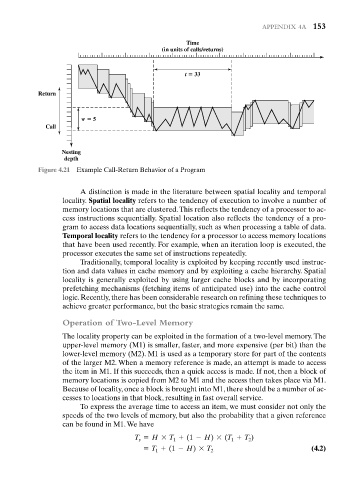
           Figure 4.21 Example Call-Return Behavior of a Program

                       A distinction is made in the literature between spatial locality and temporal
                  locality. Spatial locality refers to the tendency of execution to involve a number of
                  memory locations that are clustered.This reflects the tendency of a processor to ac-
                  cess instructions sequentially. Spatial location also reflects the tendency of a pro-
                  gram to access data locations sequentially, such as when processing a table of data.
                  Temporal locality refers to the tendency for a processor to access memory locations
                  that have been used recently. For example, when an iteration loop is executed, the
                  processor executes the same set of instructions repeatedly.
                       Traditionally, temporal locality is exploited by keeping recently used instruc-
                  tion and data values in cache memory and by exploiting a cache hierarchy. Spatial
                  locality is generally exploited by using larger cache blocks and by incorporating
                  prefetching mechanisms (fetching items of anticipated use) into the cache control
                  logic. Recently, there has been considerable research on refining these techniques to
                  achieve greater performance, but the basic strategies remain the same.

                  Operation of Two-Level Memory
                  The locality property can be exploited in the formation of a two-level memory. The
                  upper-level memory (M1) is smaller, faster, and more expensive (per bit) than the
                  lower-level memory (M2). M1 is used as a temporary store for part of the contents
                  of the larger M2. When a memory reference is made, an attempt is made to access
                  the item in M1. If this succeeds, then a quick access is made. If not, then a block of
                  memory locations is copied from M2 to M1 and the access then takes place via M1.
                  Because of locality, once a block is brought into M1, there should be a number of ac-
                  cesses to locations in that block, resulting in fast overall service.
                       To express the average time to access an item, we must consider not only the
                  speeds of the two levels of memory, but also the probability that a given reference
                  can be found in M1.We have
                                        T = H * T + (1 - H) * (T + T )
                                                                1
                                                                     2
                                                1
                                       s
                                         = T + (1 - H) * T 2                          (4.2)
                                            1

