


Page 476 - Construction Waterproofing Handbook
P. 476
12.16   CHAPTER TWELVE


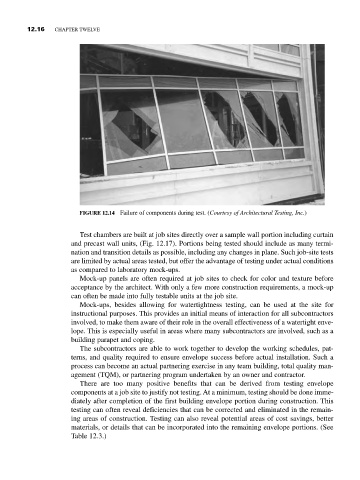
                         FIGURE 12.14 Failure of components during test. (Courtesy of Architectural Testing, Inc.)


                         Test chambers are built at job sites directly over a sample wall portion including curtain
                      and precast wall units, (Fig. 12.17). Portions being tested should include as many termi-
                      nation and transition details as possible, including any changes in plane. Such job-site tests
                      are limited by actual areas tested, but offer the advantage of testing under actual conditions
                      as compared to laboratory mock-ups.
                         Mock-up panels are often required at job sites to check for color and texture before
                      acceptance by the architect. With only a few more construction requirements, a mock-up
                      can often be made into fully testable units at the job site.
                         Mock-ups, besides allowing for watertightness testing, can be used at the site for
                      instructional purposes. This provides an initial means of interaction for all subcontractors
                      involved, to make them aware of their role in the overall effectiveness of a watertight enve-
                      lope. This is especially useful in areas where many subcontractors are involved, such as a
                      building parapet and coping.
                         The subcontractors are able to work together to develop the working schedules, pat-
                      terns, and quality required to ensure envelope success before actual installation. Such a
                      process can become an actual partnering exercise in any team building, total quality man-
                      agement (TQM), or partnering program undertaken by an owner and contractor.
                         There are too many positive benefits that can be derived from testing envelope
                      components at a job site to justify not testing. At a minimum, testing should be done imme-
                      diately after completion of the first building envelope portion during construction. This
                      testing can often reveal deficiencies that can be corrected and eliminated in the remain-
                      ing areas of construction. Testing can also reveal potential areas of cost savings, better
                      materials, or details that can be incorporated into the remaining envelope portions. (See
                      Table 12.3.)

