


Page 478 - Construction Waterproofing Handbook
P. 478
12.18   CHAPTER TWELVE


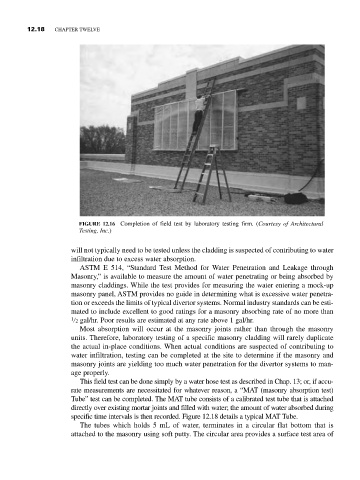
                         FIGURE 12.16 Completion of field test by laboratory testing firm. (Courtesy of  Architectural
                         Testing, Inc.)

                      will not typically need to be tested unless the cladding is suspected of contributing to water
                      infiltration due to excess water absorption.
                         ASTM E 514, “Standard  Test Method for  Water Penetration and Leakage through
                      Masonry,” is available to measure the amount of water penetrating or being absorbed by
                      masonry claddings. While the test provides for measuring the water entering a mock-up
                      masonry panel, ASTM provides no guide in determining what is excessive water penetra-
                      tion or exceeds the limits of typical divertor systems. Normal industry standards can be esti-
                      mated to include excellent to good ratings for a masonry absorbing rate of no more than
                      1  2 gal/hr. Poor results are estimated at any rate above 1 gal/hr.
                         Most absorption will occur at the masonry joints rather than through the masonry
                      units. Therefore, laboratory testing of a specific masonry cladding will rarely duplicate
                      the actual in-place conditions. When actual conditions are suspected of contributing to
                      water infiltration, testing can be completed at the site to determine if the masonry and
                      masonry joints are yielding too much water penetration for the divertor systems to man-
                      age properly.
                         This field test can be done simply by a water hose test as described in Chap. 13; or, if accu-
                      rate measurements are necessitated for whatever reason, a “MAT (masonry absorption test)
                      Tube” test can be completed. The MAT tube consists of a calibrated test tube that is attached
                      directly over existing mortar joints and filled with water; the amount of water absorbed during
                      specific time intervals is then recorded. Figure 12.18 details a typical MAT Tube.
                         The tubes which holds 5 mL of water, terminates in a circular flat bottom that is
                      attached to the masonry using soft putty. The circular area provides a surface test area of

