


Page 479 - Construction Waterproofing Handbook
P. 479
ENVELOPE TESTING  12.19


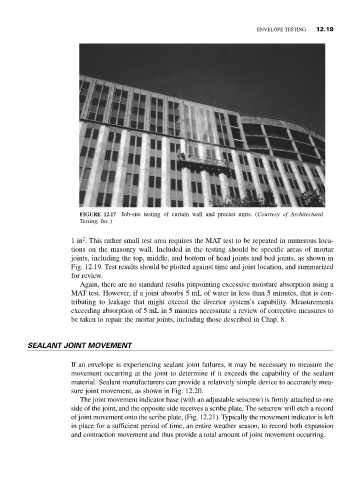
                            FIGURE 12.17 Job-site testing of curtain wall and precast units. (Courtesy of  Architectural
                            Testing, Inc.)


                             2
                         1 in . This rather small test area requires the MAT test to be repeated in numerous loca-
                         tions on the masonry wall. Included in the testing should be specific areas of mortar
                         joints, including the top, middle, and bottom of head joints and bed joints, as shown in
                         Fig. 12.19. Test results should be plotted against time and joint location, and summarized
                         for review.
                            Again, there are no standard results pinpointing excessive moisture absorption using a
                         MAT test. However, if a joint absorbs 5 mL of water in less than 5 minutes, that is con-
                         tributing to leakage that might exceed the divertor system’s capability. Measurements
                         exceeding absorption of 5 mL in 5 minutes necessitate a review of corrective measures to
                         be taken to repair the mortar joints, including those described in Chap. 8.


             SEALANT JOINT MOVEMENT

                         If an envelope is experiencing sealant joint failures, it may be necessary to measure the
                         movement occurring at the joint to determine if it exceeds the capability of the sealant
                         material. Sealant manufacturers can provide a relatively simple device to accurately mea-
                         sure joint movement, as shown in Fig. 12.20.
                            The joint movement indicator base (with an adjustable setscrew) is firmly attached to one
                         side of the joint, and the opposite side receives a scribe plate. The setscrew will etch a record
                         of joint movement onto the scribe plate, (Fig. 12.21). Typically the movement indicator is left
                         in place for a sufficient period of time, an entire weather season, to record both expansion
                         and contraction movement and thus provide a total amount of joint movement occurring.

