


Page 620 - Corrosion Engineering Principles and Practice
P. 620
582   C h a p t e r   1 3                              C a t h o d i c   P r o t e c t i o n    583


                      CP systems, causing significant currents (and therefore voltage drops)
                      to occur in the flowlines connecting the components.
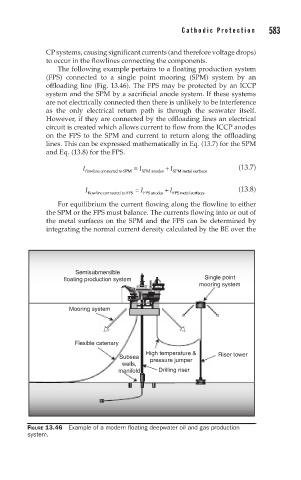
                         The following example pertains to a floating production system
                      (FPS)  connected  to  a  single  point  mooring  (SPM)  system  by  an
                      offloading line (Fig. 13.46). The FPS may be protected by an ICCP
                      system and the SPM by a sacrificial anode system. If these systems
                      are not electrically connected then there is unlikely to be interference
                      as  the  only  electrical  return  path  is  through  the  seawater  itself.
                      However, if they are connected by the offloading lines an electrical
                      circuit is created which allows current to flow from the ICCP anodes
                      on  the  FPS  to  the  SPM  and  current  to  return  along  the  offloading
                      lines. This can be expressed mathematically in Eq. (13.7) for the SPM
                      and Eq. (13.8) for the FPS.

                                I             =  I     +  I                (13.7)
                                 flowline connected to SPM  SPM anodes  SPM metal surfaces

                                 I            =  I     +  I                (13.8)
                                 flowline connected to FPS  FPS anodes  FPS metal surfaces
                         For equilibrium the current flowing along the flowline to either
                      the SPM or the FPS must balance. The currents flowing into or out of
                      the metal surfaces on the SPM and the FPS can be determined by
                      integrating the normal current density calculated by the BE over the


                              Semisubmersible
                           floating production system            Single point
                                                                mooring system


                            Mooring system


                              Flexible catenary
                                                 High temperature &   Riser tower
                                          Subsea   pressure jumper
                                           wells,
                                          manifold   Drilling riser


                 FIGURE 13.46  Example of a modern floating deepwater oil and gas production
                 system.

