


Page 183 -
P. 183
162    CHAPTER 13 Rollout and sustain


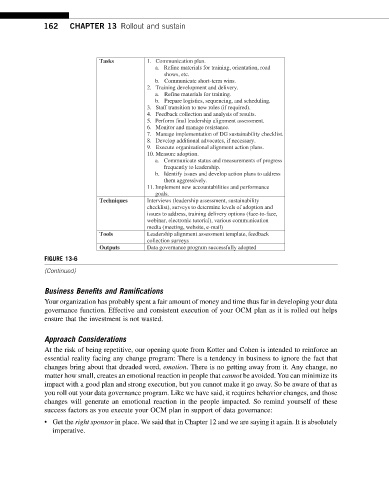
                             Tasks        1. Communication plan.
                                            a. Refine materials for training, orientation, road
                                               shows, etc.
                                            b. Communicate short-term wins.
                                          2. Training development and delivery.
                                            a. Refine materials for training.
                                            b. Prepare logistics, sequencing, and scheduling.
                                          3. Staff transition to new roles (if required).
                                          4. Feedback collection and analysis of results.
                                          5. Perform final leadership alignment assessment.
                                          6. Monitor and manage resistance.
                                          7. Manage implementation of DG sustainability checklist.
                                          8. Develop additional advocates, if necessary.
                                          9. Execute organizational alignment action plans.
                                          10. Measure adoption.
                                            a. Communicate status and measurements of progress
                                               frequently to leadership.
                                            b. Identify issues and develop action plans to address
                                               them aggressively.
                                          11. Implement new accountabilities and performance
                                            goals.
                             Techniques    Interviews (leadership assessment, sustainability
                                          checklist), surveys to determine levels of adoption and
                                          issues to address, training delivery options (face-to-face,
                                          webinar, electronic tutorial), various communication
                                          media (meeting, website, e-mail)
                             Tools        Leadership alignment assessment template, feedback
                                          collection surveys
                             Outputs      Data governance program successfully adopted
             FIGURE 13-6
             (Continued)


             Business Benefits and Ramifications

             Your organization has probably spent a fair amount of money and time thus far in developing your data
             governance function. Effective and consistent execution of your OCM plan as it is rolled out helps
             ensure that the investment is not wasted.
             Approach Considerations

             At the risk of being repetitive, our opening quote from Kotter and Cohen is intended to reinforce an
             essential reality facing any change program: There is a tendency in business to ignore the fact that
             changes bring about that dreaded word, emotion. There is no getting away from it. Any change, no
             matter how small, creates an emotional reaction in people that cannot be avoided. You can minimize its
             impact with a good plan and strong execution, but you cannot make it go away. So be aware of that as
             you roll out your data governance program. Like we have said, it requires behavior changes, and those
             changes will generate an emotional reaction in the people impacted. So remind yourself of these
             success factors as you execute your OCM plan in support of data governance:
             • Get the right sponsor in place. We said that in Chapter 12 and we are saying it again. It is absolutely
                imperative.

