


Page 129 - Design for Six Sigma for Service (Six SIGMA Operational Methods)
P. 129
104   Chapter Six

        Before QFD can be implemented, a multidisciplinary DFSS team needs to
        be in place and more time should be spent upstream understanding customer
        needs and expectations and defining the product or service in greater detail.

        There are many initial realistic concerns that must be addressed in order to
        implement QFD successfully. For example, departments represented in the
        team do not tend to talk to one another. In addition, market research
        information is not technically or design focused, and QFD is more easily
        applied to incremental design than to brand creative design. The traditional
        reality that problem prevention is not rewarded as well as problem solving
        will be faced initially be the DFSS team. This “reality” will fade away as the
        team embarks on its project using the rigor of DFSS.


        6.4 QFD Methodology Overview

        Quality function deployment is accomplished by multidisciplinary DFSS
        teams using a series of charts to deploy critical customer attributes
        throughout the phases of design development. QFD is usually deployed in
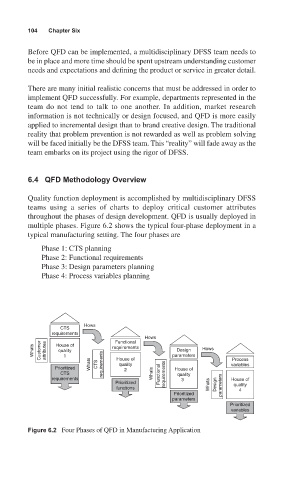
        multiple phases. Figure 6.2 shows the typical four-phase deployment in a
        typical manufacturing setting. The four phases are
            Phase 1: CTS planning
            Phase 2: Functional requirements
            Phase 3: Design parameters planning
            Phase 4: Process variables planning


                       Hows
                 CTS
               requirements
                                       Hows
                               Functional
          Whats  Customer  attributes  House of  requirements  parameters  Hows
                                                Design
                quality
                  1
                                                              Process
                         Whats  CTS  requirements  House of   variables
                                quality
               Prioritized        2            House of
                 CTS                     Whats  Functional  requirements  quality
               requirements                      3            House of
                               Prioritized              Whats  Design  quality
                                functions                  parameters  4
                                               Prioritized
                                              parameters
                                                              Prioritized
                                                              variables
        Figure 6.2 Four Phases of QFD in Manufacturing Application

