


Page 527 - Design of Reinforced Masonry Structures
P. 527
SHEAR WALLS                       7.89

             3.  Determine seismic design category.
                (a) Daycare facility: Occupancy Category III, based on S  = 1.17 > 0.5, S  is D
                                                                   DC
                                                       DS
                    Based on S  = 0.7 > 0.2, SDC is D.
                            D1
                    But S  = 0.81 > 0.75; therefore, for this Occupancy Category III building,
                        1
                    SDC is E.
                (b) Police station: Occupancy Category IV, based on S  = 1.17 > 0.5, S  is D
                                                                  DC
                                                      DS
                    Based on S  = 0.7 > 0.2, SDC is D.
                            D1
                    But S  = 0.81 > 0.75; therefore, for this Occupancy Category IV building,
                        1
                    SDC is F.
         7.10.3 Design for Flexure
         A shear wall is necessarily subjected to forces in two perpendicular planes. It receives lat-
         eral loads perpendicular to wall (the out-of-plane lateral loads) that cause the wall to bend
         out-of-plane, a topic discussed in Chap. 6. Additionally, it receives in-plane lateral loads
         which it resists as a shear wall. Procedure for designing a wall as a shear wall is discussed
         in this section. Although these two sets of forces are not assumed to act concurrently, the
         wall must be adequate to resist these two sets of forces independently.
           A shear wall is analyzed as a vertical beam. Under the action of in-plane lateral force
         acting on the wall, the wall is subjected to shear as well as moment. For a single-story wall,
         the magnitude of this moment equals the lateral force times the wall height. In addition, the
         wall is subjected to a seismic lateral force at the midheight due to its own inertia. This inertial
         force equals the seismic coefficient times the self-weight of the wall, and the moment due
         to this lateral force equals this force times the distance from the center of gravity of mass of
         the wall to the base. In a single-story building, this moment is added to the moment caused
         by the in-plane lateral force applied at the top of wall. See Example 7.16. In multistory shear
         walls, the self-weight of walls is lumped the with the masses tributary at various floor levels.
         The shear wall is subjected to in-plane lateral force at each diaphragm level as well as inertial
         forces due to the self-weight of shear walls themselves, which act at the centers of gravity of
         their tributary masses. The wall must be designed for all forces that it must resist.
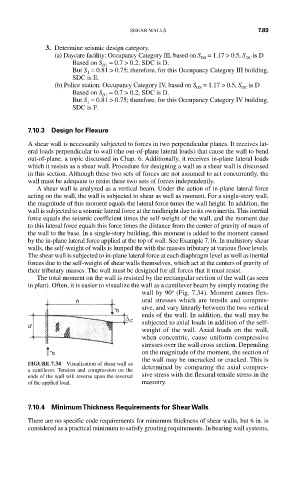
           The total moment on the wall is resisted by the rectangular section of the wall (as seen
         in plan). Often, it is easier to visualize the wall as a cantilever beam by simply rotating the
                                               o
                                       wall by 90  (Fig. 7.34). Moment causes flex-
                     h                 ural stresses which are tensile and compres-
                                       sive, and vary linearly between the two vertical
                                P
                                       ends of the wall. In addition, the wall may be
                                   ∆ C  subjected to axial loads in addition of the self-
         d
                                       weight of the wall. Axial loads on the wall,
                                       when concentric, cause uniform compressive
                                       stresses over the wall cross section. Depending
                                       on the magnitude of the moment, the section of
               P
                                       the wall may be uncracked or cracked. This is
         FIGURE 7.34  Visualization of shear wall as
         a cantilever. Tension and compression on the   determined by comparing the axial compres-
         ends of the wall will reverse upon the reversal   sive stress with the flexural tensile stress in the
         of the applied load.          masonry.
         7.10.4  Minimum Thickness Requirements for Shear Walls

         There are no specific code requirements for minimum thickness of shear walls, but 6 in. is
         considered as a practical minimum to satisfy grouting requirements. In bearing wall systems,

