


Page 528 - Design of Reinforced Masonry Structures
P. 528
7.90                      CHAPTER SEVEN

         load-bearing walls might also be acting as shear walls. Typical wall thickness would be 8-
         in. nominal. Larger thickness might be required for tall structures. A discussion on available
         thicknesses of masonry hollow units is presented in Chap. 3. It might be preferable and
         economical to use higher-strength masonry rather than larger size units, which would be
         heavier and require more space to build. Nominal 8-in. walls have been used for examples
         in this chapter.


         7.10.5  Design Shear Strength

         The shear strength of shear walls can be determined in a manner similar to that used for
         beams, columns, and piers (see examples in Chaps. 4 and 5). However, to minimize the pos-
         sibility of brittle failure of shear walls in structures built in high seismic regions, the design
         strength of such shear walls is determined a bit differently. The procedure of determining
         the nominal shear strength of such shear walls is specified in MSJC-08 Section 3.3.6, and
         explained in MSJC-08 Commentary Section 3.3.6.5.3. The model presented in the follow-
         ing discussion is based on 2006 IBC Section 2106.5.2. The strength reduction factor, f, to
         be used in conjunction with nominal shear strength is 0.8 (MSJC-08 Section 3.1.4.3).
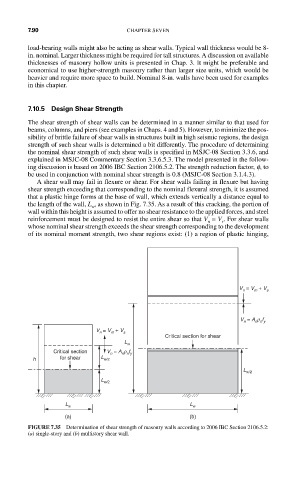
           A shear wall may fail in flexure or shear. For shear walls failing in flexure but having
         shear strength exceeding that corresponding to the nominal flexural strength, it is assumed
         that a plastic hinge forms at the base of wall, which extends vertically a distance equal to
         the length of the wall, L , as shown in Fig. 7.35. As a result of this cracking, the portion of
                          w
         wall within this height is assumed to offer no shear resistance to the applied forces, and steel
         reinforcement must be designed to resist the entire shear so that V  = V . For shear walls
                                                             s
                                                         n
         whose nominal shear strength exceeds the shear strength corresponding to the development
         of its nominal moment strength, two shear regions exist: (1) a region of plastic hinging,


                                                                 V n  = V m  + V s


                                                                  V n  = A n r n f y
                           V n  = V m  + V s
                                             Critical section for shear
                                  L w
               Critical section  V n  = A n r n f y
          h      for shear  L w/2

                                                                  L w/2
                            L w/2


                   L w                              L w
                   (a)                              (b)
         FIGURE 7.35  Determination of shear strength of masonry walls according to 2006 IBC Section 2106.5.2:
         (a) single-story and (b) multistory shear wall.

