


Page 162 - Designing Autonomous Mobile Robots : Inside the Mindo f an Intellegent Machine
P. 162
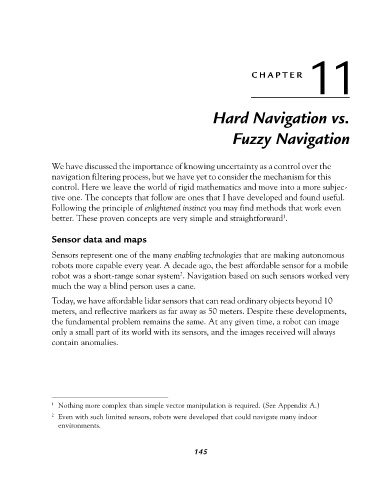
11
                                                                       CHAPTER


                                                            Hard Navigation vs.


                                                                  Fuzzy Navigation


               We have discussed the importance of knowing uncertainty as a control over the
               navigation filtering process, but we have yet to consider the mechanism for this
               control. Here we leave the world of rigid mathematics and move into a more subjec-
               tive one. The concepts that follow are ones that I have developed and found useful.
               Following the principle of enlightened instinct you may find methods that work even
                                                                                1
               better. These proven concepts are very simple and straightforward .

               Sensor data and maps

               Sensors represent one of the many enabling technologies that are making autonomous
               robots more capable every year. A decade ago, the best affordable sensor for a mobile
                                                   2
               robot was a short-range sonar system . Navigation based on such sensors worked very
               much the way a blind person uses a cane.

               Today, we have affordable lidar sensors that can read ordinary objects beyond 10
               meters, and reflective markers as far away as 50 meters. Despite these developments,
               the fundamental problem remains the same. At any given time, a robot can image
               only a small part of its world with its sensors, and the images received will always
               contain anomalies.


               1  Nothing more complex than simple vector manipulation is required. (See Appendix A.)
               2  Even with such limited sensors, robots were developed that could navigate many indoor
                 environments.


                                                       145

