


Page 229 - Designing Autonomous Mobile Robots : Inside the Mindo f an Intellegent Machine
P. 229
Chapter 14

            the agent does not compensate for the movement of the robot during this period, then
            the correction will be in error by that amount.
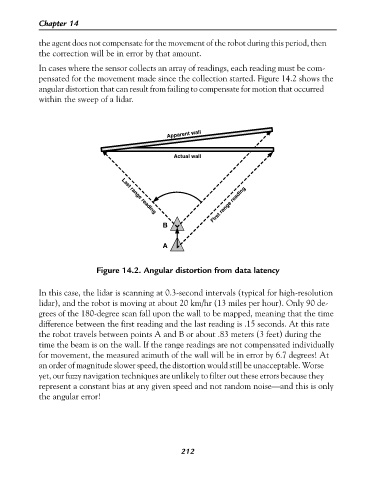
            In cases where the sensor collects an array of readings, each reading must be com-
            pensated for the movement made since the collection started. Figure 14.2 shows the
            angular distortion that can result from failing to compensate for motion that occurred
            within the sweep of a lidar.


                                               Apparent wall


                                                 Actual wall


                                                            First range reading


                                   Last range reading
                                              B

                                              A


                            Figure 14.2. Angular distortion from data latency


            In this case, the lidar is scanning at 0.3-second intervals (typical for high-resolution
            lidar), and the robot is moving at about 20 km/hr (13 miles per hour). Only 90 de-
            grees of the 180-degree scan fall upon the wall to be mapped, meaning that the time
            difference between the first reading and the last reading is .15 seconds. At this rate
            the robot travels between points A and B or about .83 meters (3 feet) during the
            time the beam is on the wall. If the range readings are not compensated individually
            for movement, the measured azimuth of the wall will be in error by 6.7 degrees! At
            an order of magnitude slower speed, the distortion would still be unacceptable. Worse
            yet, our fuzzy navigation techniques are unlikely to filter out these errors because they
            represent a constant bias at any given speed and not random noise—and this is only
            the angular error!


                                                   212

