


Page 232 - Designing Autonomous Mobile Robots : Inside the Mindo f an Intellegent Machine
P. 232
Becoming Unstuck in Time

               As we have seen, even a GPS system does not offer us an azimuth estimate without
               moving. True, if our vehicle was fairly long we could mount receivers on the front
               and back to obtain a heading estimate, but what we are really doing is establishing
               two simultaneous time-places.

               For instance, if a robot is traveling down a hall using lidar or sonar it may receive
               frequent lateral and azimuth corrections, but no longitudinal corrections for some
               distance. Eventually it should reach a point where it can image a feature that indi-
               cates its longitudinal position. Therefore, odometry is the key to gluing together
               these cues about the environment. In this case, it is necessary that the odometry be
               accurate enough longitudinally (distance traveled) to keep the position estimate
               intact.
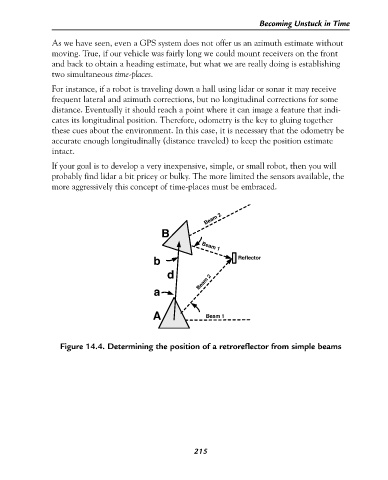
               If your goal is to develop a very inexpensive, simple, or small robot, then you will
               probably find lidar a bit pricey or bulky. The more limited the sensors available, the
               more aggressively this concept of time-places must be embraced.


                                                          Beam 2

                                              B          Beam 1


                                            b                      Reflector

                                               d
                                                        Beam 2
                                            a


                                            A             Beam 1


                  Figure 14.4. Determining the position of a retroreflector from simple beams


                                                       215

