


Page 230 - Designing Autonomous Mobile Robots : Inside the Mindo f an Intellegent Machine
P. 230
Becoming Unstuck in Time

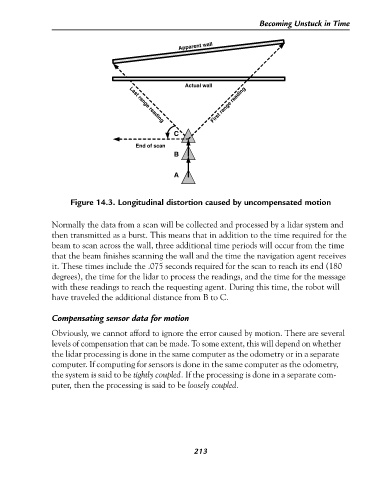
                                                   Apparent wall


                                                    Actual wall
                                                            First range reading


                                     Last range reading
                                                 C
                                       End of scan
                                                 B


                                                 A


                     Figure 14.3. Longitudinal distortion caused by uncompensated motion


               Normally the data from a scan will be collected and processed by a lidar system and
               then transmitted as a burst. This means that in addition to the time required for the
               beam to scan across the wall, three additional time periods will occur from the time
               that the beam finishes scanning the wall and the time the navigation agent receives
               it. These times include the .075 seconds required for the scan to reach its end (180
               degrees), the time for the lidar to process the readings, and the time for the message
               with these readings to reach the requesting agent. During this time, the robot will
               have traveled the additional distance from B to C.

               Compensating sensor data for motion

               Obviously, we cannot afford to ignore the error caused by motion. There are several
               levels of compensation that can be made. To some extent, this will depend on whether
               the lidar processing is done in the same computer as the odometry or in a separate
               computer. If computing for sensors is done in the same computer as the odometry,
               the system is said to be tightly coupled. If the processing is done in a separate com-
               puter, then the processing is said to be loosely coupled.


                                                       213

