


Page 106 - Dynamic Loading and Design of Structures
P. 106
Page 83

                 The vortex street proves to have a characteristic geometry, scaled to the diameter D,
               irrespective of windspeed; for the circular section, the distance between successive vortices on
               the same side is a little under 5D. As the vortices are carried downstream at a speed only
               marginally less than the flow V, this implies that the cycle periodicity, equal to the time
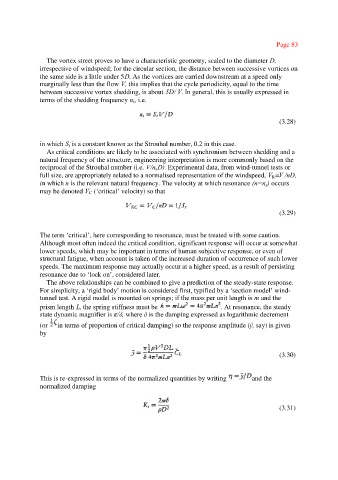
               between successive vortex shedding, is about 5D/ V. In general, this is usually expressed in
               terms of the shedding frequency ns, i.e.


                                                                                                   (3.28)


               in which S is a constant known as the Strouhal number, 0.2 in this case.
                         t
                 As critical conditions are likely to be associated with synchronism between shedding and a
               natural frequency of the structure, engineering interpretation is more commonly based on the
               reciprocal of the Strouhal number (i.e. V/n D). Experimental data, from wind-tunnel tests or
                                                        s
               full size, are appropriately related to a normalised representation of the windspeed, V =V /nD,
                                                                                                 R
               in which n is the relevant natural frequency. The velocity at which resonance (n=n ) occurs
                                                                                              s
               may be denoted VC (‘critical’ velocity) so that


                                                                                                   (3.29)


               The term ‘critical’, here corresponding to resonance, must be treated with some caution.
               Although most often indeed the critical condition, significant response will occur at somewhat
               lower speeds, which may be important in terms of human subjective response, or even of
               structural fatigue, when account is taken of the increased duration of occurrence of such lower
               speeds. The maximum response may actually occur at a higher speed, as a result of persisting
               resonance due to ‘lock on’, considered later.
                 The above relationships can be combined to give a prediction of the steady-state response.
               For simplicity, a ‘rigid body’ motion is considered first, typified by a ‘section model’ wind-
               tunnel test. A rigid model is mounted on springs; if the mass per unit length is m and the
               prism length L, the spring stiffness must be                    . At resonance, the steady
               state dynamic magnifier is πδwhere δis the damping expressed as logarithmic decrement
                                          /
                                            ,
               (or   in terms of proportion of critical damping) so the response amplitude (ŷsay) is given
                                                                                          ,
               by


                                                                                                   (3.30)


               This is re-expressed in terms of the normalized quantities by writing      and the
               normalized damping


                                                                                                   (3.31)

