


Page 111 - Dynamic Loading and Design of Structures
P. 111
Page 88

               problem of the procedures developed for gust response analysis. This has proved particularly
               fruitful for circular sections in the transcritical flow regime and in the presence of turbulence
               in the incident flow (Vickery and Basu, 1984; ESDU, 1986a).
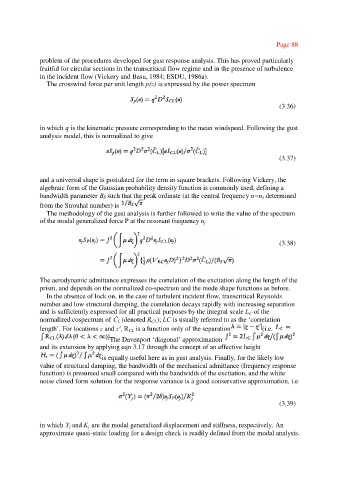
                 The crosswind force per unit length p(z) is expressed by the power spectrum


                                                                                                   (3.36)


               in which q is the kinematic pressure corresponding to the mean windspeed. Following the gust
               analysis model, this is normalized to give


                                                                                                   (3.37)


               and a universal shape is postulated for the term in square brackets. Following Vickery, the
               algebraic form of the Gaussian probability density function is commonly used, defining a
               bandwidth parameter BS such that the peak ordinate (at the central frequency n=ns determined
               from the Strouhal number) is
                 The methodology of the gust analysis is further followed to write the value of the spectrum
               of the modal generalized force P at the resonant frequency n j


                                                                                                   (3.38)


               The aerodynamic admittance expresses the correlation of the excitation along the length of the
               prism, and depends on the normalized co-spectrum and the mode shape functions as before.
                 In the absence of lock on, in the case of turbulent incident flow, transcritical Reynolds
               number and low structural damping, the correlation decays rapidly with increasing separation
               and is sufficiently expressed for all practical purposes by the integral scale L of the
                                                                                         C
               normalized cospectrum of Č (denoted R ); LC is usually referred to as the ‘correlation
                                                      CL
                                          L
               length’. For locations z and z', R CL  is a function only of the separation   (i.e.
                                        The Davenport ‘diagonal’ approximation
               and its extension by applying eqn 3.17 through the concept of an effective height

                                     is equally useful here as in gust analysis. Finally, for the likely low
               value of structural damping, the bandwidth of the mechanical admittance (frequency response
               function) is presumed small compared with the bandwidth of the excitation, and the white
               noise closed form solution for the response variance is a good conservative approximation, i.e.


                                                                                                   (3.39)


               in which Y and K are the modal generalized displacement and stiffness, respectively. An
                                j
                         j
               approximate quasi-static loading for a design check is readily defined from the modal analysis.

