


Page 116 - Dynamic Loading and Design of Structures
P. 116
Page 93

               implies the presumption of a substantial intensity of turbulence. clat is given as 0.7 for
                                                    2
                                               5
               Reynolds number less than 3×10 (nD =0.2), falling rapidly to 0.2, which is applicable for
                      2
                                                                                       2
               1.5<nD <12. The eventual transcritical value is clat=0.3 only reached at nD =30.
                 Further review of the Eurocode procedure is given by Dyrbye and Hansen (1997), with
               extensive comment on recent practical experience and design comparisons with the Canadian
               recommendations. It is interesting to note that procedures with broad differences in
               formulation converge to give similar predictions for middle of the range structures.


                            3.2.8 Vortex shedding: design impact and countermeasures
               It was suggested in Section 3.2.4 that individual structural members may benefit from the
               intrinsic weakness of excitation in the range      , which for bracing members in trusses
               with full continuity connections implies limitation of L/D to about 33, corresponding to a
               structural slenderness ratio of 0.7L/r=65. As a more slender member is commonly more
               economic structurally, exploration of the limit of the favourable range is highly desirable. A
               sophisticated extension of the simple Reynolds’ number has been presented by ESDU (1986a)
               taking account of small scale components of turbulence and the surface roughness of the
               structure to give an effective value R . This is difficult to interpret and to calibrate against
                                                  ee
               existing experience, especially with regard to surface roughness. The lower limit of the
                                                                                       2
               favourable range should therefore not be presumed substantially below nD =1 .
                 A greater L/D implies subcritical resonance, and to ensure freedom from the lock on
               enhancement of excitation (and of the cumulative time over which sufficient response to
               cause fatigue damage could be sustained) a high value of K is called for; K =25 has been
                                                                        s
                                                                                       s
               suggested in guidance for welded tubular towers for service offshore prepared on behalf of the
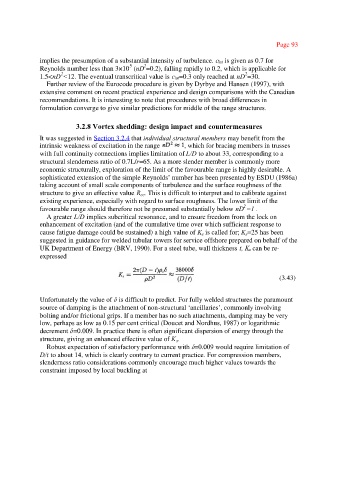
               UK Department of Energy (BRV, 1990). For a steel tube, wall thickness t, Ks can be re-
               expressed


                                                                                                   (3.43)


               Unfortunately the value of δis difficult to predict. For fully welded structures the paramount
               source of damping is the attachment of non-structural ‘ancillaries’, commonly involving
               bolting and/or frictional grips. If a member has no such attachments, damping may be very
               low, perhaps as low as 0.15 per cent critical (Doucet and Nordhus, 1987) or logarithmic
               decrement δ=0.009. In practice there is often significant dispersion of energy through the
               structure, giving an enhanced effective value of K .
                                                               s
                 Robust expectation of satisfactory performance with δ0.009 would require limitation of
                                                                     =
               D/t to about 14, which is clearly contrary to current practice. For compression members,
               slenderness ratio considerations commonly encourage much higher values towards the
               constraint imposed by local buckling at

