


Page 119 - Dynamic Loading and Design of Structures
P. 119
Page 96

               proportional to the Scruton number, is therefore used for prediction and scaling of wind tunnel
               results. The section depth (d) is generally used both for reduced velocity and Scruton number
               definition, revealing a somewhat clearer pattern than the option of normalization on the deck
               width (B). Typically, the reduced velocity V =V /nd is given by VRC=64+0.5B/d for sections
                                                              c
                                                         RC
               with B/d<6, V =1.5B/d for more slender sections, but with considerable scatter (cf. figure 2
                            RC
               in Wyatt and Scruton, 1981).
                 Excitation strength is very sensitive to details of the cross-section, especially at the leading
               edge, and (because of the feedback by lock-on) may be sensitive to damping. Very low scaled
               wind tunnel speeds may also create problems if the full bridge is modelled. The section model
               technique, using a large-scale model of a fraction of the span which is spring borne with
               independently controllable frequencies and damping is most strongly desirable for this
               purpose. Unfortunately, it is then not possible to model atmospheric turbulence at correct
               scale. The effects of turbulence should be thought of as comprising two distinct actions: the
               lower spectral frequencies which reflect large size gusts will be seen as a change in the
               incident speed, while the high frequencies are associated with localized momentum transfer
               affecting the boundary layer and tending to promote reattachment of separated flow. The
               former may be overborne by lock-on in conditions of modest turbulence, while the latter is
               generally beneficial.
                 There are much larger numbers of road bridges and viaducts in the span range up to about
               70 m, but commonly in locations where much greater turbulence is the norm. In most cases
               the critical speed is sufficient to be out of range, or at least sufficiently high to make
               subjective response to motion of little practical concern and to give only a low potential rate
               of accumulation of fatigue cycles. Care should be taken that the high frequency components
               of turbulence are not over-represented in testing, suggesting a lower target value for the total
               intensity, as illustrated by Figure 3.5. Footbridges may give greater concern, although the
               need to avoid adverse response to pedestrian excitation commonly leads to structural forms
               giving frequencies over 3 Hz or to special provision for damping. The deck may, however, be
               thin; for example, a deck d=800 mm, B=3,200 mm at 3 Hz gives a critical speed of 19m/s. At
               a height of (say) 6m above ground, this gives the assurance of a high level of turbulence,
               typically intensity 0.25 or more. Nevertheless, robust design assessment may be difficult.
                 The UK rules BD49 were based on an extensive parametric study, which suggested that for
               decks with a slender leading edge detail in conjunction with a substantial deck cantilever
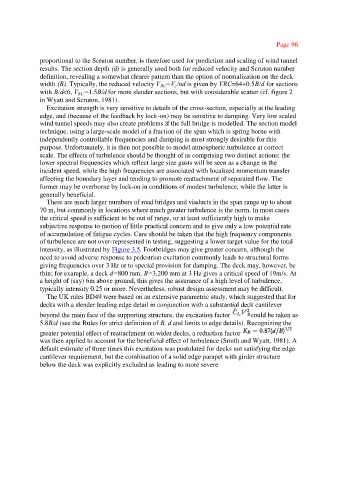
               beyond the main face of the supporting structure, the excitation factor   could be taken as
               5.8B/d (see the Rules for strict definition of B, d and limits to edge details). Recognizing the
               greater potential effect of reattachment on wider decks, a reduction factor
               was then applied to account for the beneficial effect of turbulence (Smith and Wyatt, 1981). A
               default estimate of three times this excitation was postulated for decks not satisfying the edge
               cantilever requirement, but the combination of a solid edge parapet with girder structure
               below the deck was explicitly excluded as leading to more severe

