


Page 120 - Dynamic Loading and Design of Structures
P. 120
Page 97


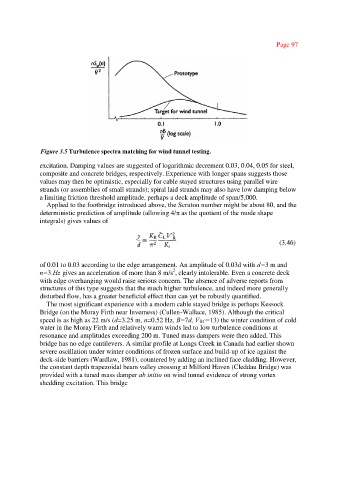
               Figure 3.5 Turbulence spectra matching for wind tunnel testing.

               excitation. Damping values are suggested of logarithmic decrement 0.03, 0.04, 0.05 for steel,
               composite and concrete bridges, respectively. Experience with longer spans suggests those
               values may then be optimistic, especially for cable stayed structures using parallel wire
               strands (or assemblies of small strands); spiral laid strands may also have low damping below
               a limiting friction threshold amplitude, perhaps a deck amplitude of span/5,000.
                 Applied to the footbridge introduced above, the Scruton number might be about 80, and the
               deterministic prediction of amplitude (allowing 4/πas the quotient of the mode shape
               integrals) gives values of


                                                                                                   (3.46)


               of 0.01 to 0.03 according to the edge arrangement. An amplitude of 0.03d with d=3 m and
                                                              2
               n=3 Hz gives an acceleration of more than 8 m/s , clearly intolerable. Even a concrete deck
               with edge overhanging would raise serious concern. The absence of adverse reports from
               structures of this type suggests that the much higher turbulence, and indeed more generally
               disturbed flow, has a greater beneficial effect than can yet be robustly quantified.
                 The most significant experience with a modern cable stayed bridge is perhaps Kessock
               Bridge (on the Moray Firth near Inverness) (Cullen-Wallace, 1985). Although the critical
               speed is as high as 22 m/s (d=3.25 m, n=0.52 Hz, B=7d, VRC=13) the winter condition of cold
               water in the Moray Firth and relatively warm winds led to low turbulence conditions at
               resonance and amplitudes exceeding 200 m. Tuned mass dampers were then added. This
               bridge has no edge cantilevers. A similar profile at Longs Creek in Canada had earlier shown
               severe oscillation under winter conditions of frozen surface and build-up of ice against the
               deck-side barriers (Wardlaw, 1981), countered by adding an inclined face cladding. However,
               the constant depth trapezoidal beam valley crossing at Milford Haven (Cleddau Bridge) was
               provided with a tuned mass damper ab initio on wind tunnel evidence of strong vortex
               shedding excitation. This bridge

