


Page 117 - Dynamic Loading and Design of Structures
P. 117
Page 94

                                                                      2.
               D/t=0.076E/fy,, which is 44 for yield stress fy=350 N/mm The Department of Energy
               guidance (BRV, 1990) includes response prediction based on the ESDU (1986a) analysis
               which appears non-robust as a result of very high sensitivity to the damping estimate. It will
                                 2
               be seen that the nD and K criteria conflict; for a given member capacity, increasing D to
                                         s
                          2
               meet an nD criterion will diminish K . This question remains controversial.
                                                   s
                                                                                                  =
                 For steel chimneys economic design commonly pushes D/t to 200 or even 250. At δ0.03
               (cf. ENV, 1991) an unlined chimney thus has        , increased for a lined chimney pro rata
               to the mass. However,         is not a robust lower bound for an unlined chimney, and
               countermeasures should generally be applied. The most common aerodynamic
               countermeasure is the spiral strake (Walshe and Wootton, 1970). This typically comprises a
               three-start spiral projecting about 0.1D. It has the disadvantage of broadly doubling the quasi-
               static wind load in the transcritical regime, the effective force coefficient related to the basic
               diameter (D) being about 1.4. Strakes are commonly applied to the top third of the stack to
               protect the first mode. A smaller drag penalty but at greater structural complexity is offered
               by the perforated shroud.
                 An alternative of increasing popularity is the addition of a damping device. A Tuned Mass
               Damper (TMD) optimized for the control of harmonic excitation can give very high values of
               Ks. In the ideal case the nominal logarithmic decrement is                  , in which mD
               is the damper mass (e.g.                       . Practical departure from optimal values of
               the damper parameters will substantially reduce this, and it is common to ‘overdamp’ the
               auxiliary mass to reduce sensitivity to error and to reduce the magnitude of its relative motion.
               ‘Sloshing fluid’ dampers are also available in proprietary form. Dampers have also been
               applied to similar problems with lighting masts (including use of elastomer inserts in the base
               mounting) and with guyed masts (including hanging chain impact dampers).
                 It is instructive to consider the cantilever first mode stress influence function. The bending
               stress at the base can be written


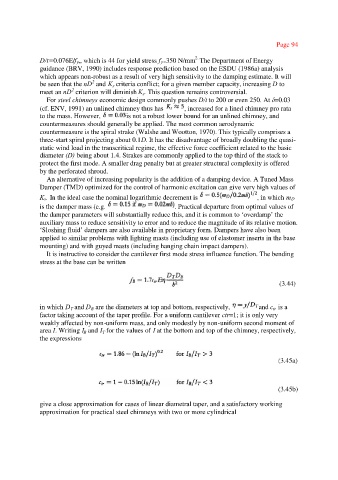
                                                                                                   (3.44)


               in which D and D are the diameters at top and bottom, respectively,          and c is a
                          T
                                 B
                                                                                                 tr
               factor taking account of the taper profile. For a uniform cantilever ctr=1; it is only very
               weakly affected by non-uniform mass, and only modestly by non-uniform second moment of
               area I. Writing I and I for the values of I at the bottom and top of the chimney, respectively,
                              B
                                     T
               the expressions

                                                                                                   (3.45a)


                                                                                                   (3.45b)


               give a close approximation for cases of linear diametral taper, and a satisfactory working
               approximation for practical steel chimneys with two or more cylindrical

