


Page 114 - Dynamic Loading and Design of Structures
P. 114
Page 91

               exceeding unity) it is arguable whether such refinement is appropriate, given the inherent
               uncertainty in this problem.
                 BS 8100 (Lattice towers and masts) uses a deterministic model with a rather complex
               notation and presentation. In the notation of this chapter, Č=0.3 (transcritical Reynolds
                                                                        L
               number is presumed) and primary resonance is assumed at V =5n D. To allow for lock on at
                                                                         cr
                                                                               j
               higher speeds, a correction factor ke is presented graphically; the graphical presentation is
                                                                                          2
               poor but it is apparently intended that windspeed 1.2Vcr gives an effective Č LV about 8 per
               cent greater than the basic value
                 Stochastic models can be expected to give a smaller response. The negative aerodynamic
               damping concept was implemented in Commentary B to the Canadian National Building
               Code (NBC) in 1980. The parameter values suggested by Vickery, as given on page 89, are
               supplemented by a formulation for admittance which can be written as J=JasKAR, in which J as
               is the Davenport ‘diagonal’ value for the correlation factor, and KAR combines allowances for
               the approximation therein and for the aerodynamic effect of the free end. The basic value
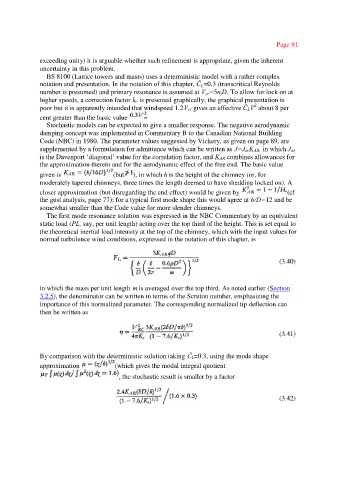
               given is                  (but   ), in which h is the height of the chimney (or, for
               moderately tapered chimneys, three times the length deemed to have shedding locked on). A
               closer approximation (but disregarding the end effect) would be given by               (cf
               the gust analysis, page 77); for a typical first mode shape this would agree at h/D=12 and be
               somewhat smaller than the Code value for more slender chimneys.
                 The first mode resonance solution was expressed in the NBC Commentary by an equivalent
               static load (PL, say, per unit length) acting over the top third of the height. This is set equal to
               the theoretical inertial load intensity at the top of the chimney, which with the input values for
               normal turbulence wind conditions, expressed in the notation of this chapter, is


                                                                                                   (3.40)


               in which the mass per unit length m is averaged over the top third. As noted earlier (Section
               3.2.5), the denominator can be written in terms of the Scruton number, emphasizing the
               importance of this normalized parameter. The corresponding normalized tip deflection can
               then be written as


                                                                                                   (3.41)


               By comparison with the deterministic solution taking Č L=0.3, using the mode shape
               approximation             (which gives the modal integral quotient

                                           , the stochastic result is smaller by a factor


                                                                                                   (3.42)

