


Page 110 - Dynamic Loading and Design of Structures
P. 110
Page 87

               supports. The dimensions must be expressed in metres. For chord members, cf is commonly
               not much greater than unity, whereas for bracing members cf is typically about 1.9
               (corresponding to EI/L values for the bracing around one-quarter of the value for the chord).
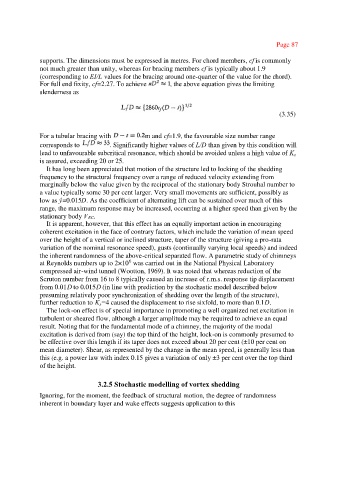
               For full end fixity, cf=2.27. To achieve      , the above equation gives the limiting
               slenderness as


                                                                                                   (3.35)


               For a tubular bracing with           m and cf=1.9, the favourable size number range
               corresponds to           . Significantly higher values of L/D than given by this condition will
               lead to unfavourable subcritical resonance, which should be avoided unless a high value of K s
               is assured, exceeding 20 or 25.
                 It has long been appreciated that motion of the structure led to locking of the shedding
               frequency to the structural frequency over a range of reduced velocity extending from
               marginally below the value given by the reciprocal of the stationary body Strouhal number to
               a value typically some 30 per cent larger. Very small movements are sufficient, possibly as
               low as ŷ=0.015D. As the coefficient of alternating lift can be sustained over much of this
               range, the maximum response may be increased, occurring at a higher speed than given by the
               stationary body VRC.
                 It is apparent, however, that this effect has an equally important action in encouraging
               coherent excitation in the face of contrary factors, which include the variation of mean speed
               over the height of a vertical or inclined structure, taper of the structure (giving a pro-rata
               variation of the nominal resonance speed), gusts (continually varying local speeds) and indeed
               the inherent randomness of the above-critical separated flow. A parametric study of chimneys
                                              6
               at Reynolds numbers up to 2×10 was carried out in the National Physical Laboratory
               compressed air-wind tunnel (Wootton, 1969). It was noted that whereas reduction of the
               Scruton number from 16 to 8 typically caused an increase of r.m.s. response tip displacement
               from 0.01D to 0.015D (in line with prediction by the stochastic model described below
               presuming relatively poor synchronization of shedding over the length of the structure),
               further reduction to K =4 caused the displacement to rise sixfold, to more than 0.1D.
                                    s
                 The lock-on effect is of special importance in promoting a well organized net excitation in
               turbulent or sheared flow, although a larger amplitude may be required to achieve an equal
               result. Noting that for the fundamental mode of a chimney, the majority of the modal
               excitation is derived from (say) the top third of the height, lock-on is commonly presumed to
               be effective over this length if its taper does not exceed about 20 per cent (±10 per cent on
               mean diameter). Shear, as represented by the change in the mean speed, is generally less than
               this (e.g. a power law with index 0.15 gives a variation of only ±3 per cent over the top third
               of the height.


                                   3.2.5 Stochastic modelling of vortex shedding

               Ignoring, for the moment, the feedback of structural motion, the degree of randomness
               inherent in boundary layer and wake effects suggests application to this

