


Page 108 - Dynamic Loading and Design of Structures
P. 108
Page 85

               of a cantilever, especially in modes other than the fundamental, may somewhat exceed unity,
               being driven by excitation at sections where the amplitude is lower.


                                  3.2.3 Vortex shedding: slender elements, cables

               In most cases the fundamental mode of vibration is the dominant concern, because this clearly
               gives the lowest critical speed. Particularly in the case of chimneys, the large (typically
               sixfold) frequency difference between first and second modes commonly has the effect that
               the critical windspeed for the second mode is in excess of the maximum that may occur at the
               location in question. At the other extreme, very slender members, including cables, may reach
               the resonance condition up to quite a high mode number. The vertical motions of the deck of
               the first Tacoma Narrows bridge that persisted for a large part of its life (as opposed to the
               eventual destructive torsional motion), providing the spectacular film footage of vehicles in
               deck waves in which they almost disappeared from view, were of this kind. The switching
               between modes with change of windspeed, up to a seven-node case at speed 14m/s, clearly
               identified vortex shedding and gave no concern for early structural failure.
                 The once familiar audible frequency vibration of overhead electric telegraph and telephone
               lines comes in this category, and this mechanism has been referred to as ‘aeolian vibration’ on
               the presumption that this was the Aeolian harp of classical mythology. Consider the
               suspenders supporting the deck of a suspension bridge. The stretched string natural frequency
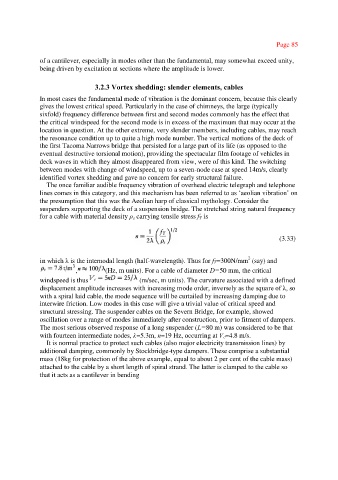
               for a cable with material density ρcarrying tensile stress f is
                                                                       T
                                                s

                                                                                                   (3.33)


                                                                                        2

               in which λis the internodal length (half-wavelength). Thus for fT=300N/mm (say) and
                            ,         (Hz, m units). For a cable of diameter D=50 mm, the critical
               windspeed is thus                  (m/sec, m units). The curvature associated with a defined
                                                                                                      ,

               displacement amplitude increases with increasing mode order, inversely as the square of λso
               with a spiral laid cable, the mode sequence will be curtailed by increasing damping due to
               interwire friction. Low modes in this case will give a trivial value of critical speed and
               structural stressing. The suspender cables on the Severn Bridge, for example, showed
               oscillation over a range of modes immediately after construction, prior to fitment of dampers.
               The most serious observed response of a long suspender (L=80 m) was considered to be that
               with fourteen intermediate nodes, λ=5.3m, n=19 Hz, occurring at Vc=4.8 m/s.
                 It is normal practice to protect such cables (also major electricity transmission lines) by
               additional damping, commonly by Stockbridge-type dampers. These comprise a substantial
               mass (18kg for protection of the above example, equal to about 2 per cent of the cable mass)
               attached to the cable by a short length of spiral strand. The latter is clamped to the cable so
               that it acts as a cantilever in bending

