


Page 107 - Dynamic Loading and Design of Structures
P. 107
Page 84

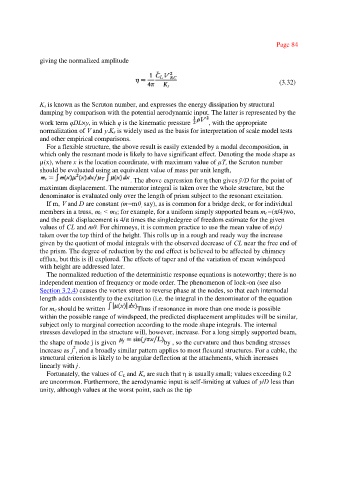
               giving the normalized amplitude


                                                                                                   (3.32)


               K is known as the Scruton number, and expresses the energy dissipation by structural
                 s
               damping by comparison with the potential aerodynamic input. The latter is represented by the
               work term qDL×y, in which q is the kinematic pressure      , with the appropriate
               normalization of V and y.Ks is widely used as the basis for interpretation of scale model tests
               and other empirical comparisons.
                 For a flexible structure, the above result is easily extended by a modal decomposition, in
               which only the resonant mode is likely to have significant effect. Denoting the mode shape as
               µ(x), where x is the location coordinate, with maximum value of µT, the Scruton number
               should be evaluated using an equivalent value of mass per unit length,

                                                                                      /
                                               . The above expression for ηthen gives ỹD for the point of

               maximum displacement. The numerator integral is taken over the whole structure, but the
               denominator is evaluated only over the length of prism subject to the resonant excitation.
                 If m, V and D are constant (m=m0 say), as is common for a bridge deck, or for individual
                                                   ,
                                                                                                   /
               members in a truss, me < m0; for example, for a uniform simply supported beam me=(π4)wo,
               and the peak displacement is 4/πtimes the singledegree of freedom estimate for the given
               values of CL and m0. For chimneys, it is common practice to use the mean value of m(x)
               taken over the top third of the height. This rolls up in a rough and ready way the increase
               given by the quotient of modal integrals with the observed decrease of CL near the free end of
               the prism. The degree of reduction by the end effect is believed to be affected by chimney
               efflux, but this is ill explored. The effects of taper and of the variation of mean windspeed
               with height are addressed later.
                 The normalized reduction of the deterministic response equations is noteworthy; there is no
               independent mention of frequency or mode order. The phenomenon of lock-on (see also
               Section 3.2.4) causes the vortex street to reverse phase at the nodes, so that each internodal
               length adds consistently to the excitation (i.e. the integral in the denominator of the equation

               for me should be written          Thus if resonance in more than one mode is possible
               within the possible range of windspeed, the predicted displacement amplitudes will be similar,
               subject only to marginal correction according to the mode shape integrals. The internal
               stresses developed in the structure will, however, increase. For a long simply supported beam,
               the shape of mode j is given                by , so the curvature and thus bending stresses
                           2
               increase as j , and a broadly similar pattern applies to most flexural structures. For a cable, the
               structural criterion is likely to be angular deflection at the attachments, which increases
               linearly with j.

                 Fortunately, the values of C and K  are such that ηis usually small; values exceeding 0.2
                                            L
                                                   s
               are uncommon. Furthermore, the aerodynamic input is self-limiting at values of y/D less than
               unity, although values at the worst point, such as the tip

