


Page 127 - Dynamic Loading and Design of Structures
P. 127
Page 104


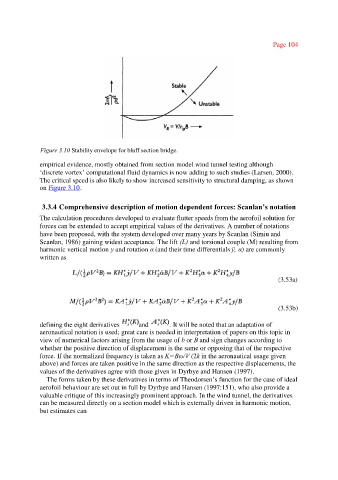
               Figure 3.10 Stability envelope for bluff section bridge.

               empirical evidence, mostly obtained from section model wind tunnel testing although
               ‘discrete vortex’ computational fluid dynamics is now adding to such studies (Larsen, 2000).
               The critical speed is also likely to show increased sensitivity to structural damping, as shown
               on Figure 3.10.


                3.3.4 Comprehensive description of motion dependent forces: Scanlan’s notation

               The calculation procedures developed to evaluate flutter speeds from the aerofoil solution for
               forces can be extended to accept empirical values of the derivatives. A number of notations
               have been proposed, with the system developed over many years by Scanlan (Simiu and
               Scanlan, 1986) gaining widest acceptance. The lift (L) and torsional couple (M) resulting from
                                                                                      )
               harmonic vertical motion y and rotation α(and their time differentials ÿ, αare commonly
               written as


                                                                                                   (3.53a)


                                                                                                   (3.53b)

               defining the eight derivatives     and        . It will be noted that an adaptation of
               aeronautical notation is used; great care is needed in interpretation of papers on this topic in
               view of numerical factors arising from the usage of b or B and sign changes according to
               whether the positive direction of displacement is the same or opposing that of the respective
                                                                 /
               force. If the normalized frequency is taken as K=BωV (2k in the aeronautical usage given
               above) and forces are taken positive in the same direction as the respective displacements, the
               values of the derivatives agree with those given in Dyrbye and Hansen (1997).
                 The forms taken by these derivatives in terms of Theodorsen’s function for the case of ideal
               aerofoil behaviour are set out in full by Dyrbye and Hansen (1997:151), who also provide a
               valuable critique of this increasingly prominent approach. In the wind tunnel, the derivatives
               can be measured directly on a section model which is externally driven in harmonic motion,
               but estimates can

