


Page 589 - Dynamics of Mechanical Systems
P. 589
0593_C16_fm  Page 570  Tuesday, May 7, 2002  7:06 AM


                       570                                                 Dynamics of Mechanical Systems


                       P16.6.2: Repeat Problem P16.6.1 if a, b, and d have the values a = 5 cm, b = 3.25 cm, and
                       d = 0.75 cm.
                       P16.6.3: Repeat Problem P16.5.1 if the follower axis is offset from the cam rotation axis by
                       3/8 in.
                       P16.6.4: Repeat Problem P16.5.2 if the follower axis is offset from the cam rotation axis by
                       1.0 cm.


                       Section 16.8  Analytical Construction of Cam Profiles
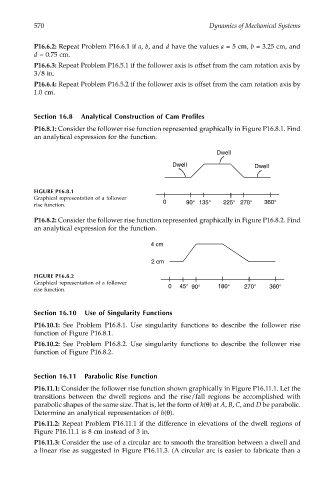
                       P16.8.1: Consider the follower rise function represented graphically in Figure P16.8.1. Find
                       an analytical expression for the function.

                                                                             Dwell
                                                                Dwell                   Dwell


                       FIGURE P16.8.1
                       Graphical representation of a follower       90° 135°               360°
                       rise function.                        0                 225°   270°

                       P16.8.2: Consider the follower rise function represented graphically in Figure P16.8.2. Find
                       an analytical expression for the function.

                                                         4 cm

                                                         2 cm

                       FIGURE P16.8.2
                       Graphical representation of a follower  0   45°  90°  180°    270°    360°
                       rise function.


                       Section 16.10  Use of Singularity Functions

                       P16.10.1: See Problem P16.8.1. Use singularity functions to describe the follower rise
                       function of Figure P16.8.1.
                       P16.10.2: See Problem P16.8.2. Use singularity functions to describe the follower rise
                       function of Figure P16.8.2.


                       Section 16.11  Parabolic Rise Function
                       P16.11.1: Consider the follower rise function shown graphically in Figure P16.11.1. Let the
                       transitions between the dwell regions and the rise/fall regions be accomplished with
                       parabolic shapes of the same size. That is, let the form of h(θ) at A, B, C, and D be parabolic.
                       Determine an analytical representation of h(θ).
                       P16.11.2: Repeat Problem P16.11.1 if the difference in elevations of the dwell regions of
                       Figure P16.11.1 is 8 cm instead of 3 in.
                       P16.11.3: Consider the use of a circular arc to smooth the transition between a dwell and
                       a linear rise as suggested in Figure P16.11.3. (A circular arc is easier to fabricate than a

