


Page 588 - Dynamics of Mechanical Systems
P. 588
0593_C16_fm  Page 569  Tuesday, May 7, 2002  7:06 AM


                       Mechanical Components: Cams                                                 569


                       Problems


                       Section 16.4  Graphical Constructions: The Follower Rise Function
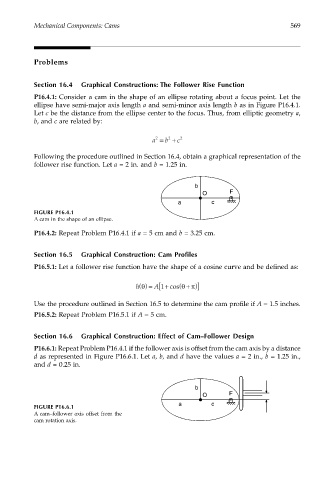
                       P16.4.1: Consider a cam in the shape of an ellipse rotating about a focus point. Let the
                       ellipse have semi-major axis length a and semi-minor axis length b as in Figure P16.4.1.
                       Let c be the distance from the ellipse center to the focus. Thus, from elliptic geometry a,
                       b, and c are related by:

                                                          a =  b +  c 2
                                                           2
                                                               2
                       Following the procedure outlined in Section 16.4, obtain a graphical representation of the
                       follower rise function. Let a = 2 in. and b = 1.25 in.


                                                                      b
                                                                         O       F
                                                                 a         c
                       FIGURE P16.4.1
                       A cam in the shape of an ellipse.

                       P16.4.2: Repeat Problem P16.4.1 if a = 5 cm and b = 3.25 cm.


                       Section 16.5  Graphical Construction: Cam Profiles
                       P16.5.1: Let a follower rise function have the shape of a cosine curve and be defined as:

                                                          A +
                                                                    +
                                                     h θ () = [1 cos ( θ π)]
                       Use the procedure outlined in Section 16.5 to determine the cam profile if A = 1.5 inches.
                       P16.5.2: Repeat Problem P16.5.1 if A = 5 cm.


                       Section 16.6  Graphical Construction: Effect of Cam–Follower Design
                       P16.6.1: Repeat Problem P16.4.1 if the follower axis is offset from the cam axis by a distance
                       d as represented in Figure P16.6.1. Let a, b, and d have the values a = 2 in., b = 1.25 in.,
                       and d = 0.25 in.


                                                                      b
                                                                         O       F
                                                                  a        c
                       FIGURE P16.6.1
                       A cam–follower axis offset from the
                       cam rotation axis.

